
Ask three suppliers for a quotation on the same LED lamp and you may still see it today: one product sheet says “A++”, one says “A+”, and one proudly prints “A” in a dark green arrow. Under the rules that have applied to light sources in the EU since 1 September 2021, at most one of those labels is legal – and it may not be the one you think. The plus-classes are gone. The scale now runs from A to G, the thresholds behind each letter are far stricter than before, and the letter a product legitimately earned in 2019 no longer means anything.
For importers and distributors of LED lighting this is not cosmetic trivia. The energy label is the compliance document your retail customers ask for first, the one market-surveillance authorities check at customs and on marketplaces, and the one field where old catalogues and new reality collide most often. This article walks through what the rescaled label actually requires, how EPREL registration works, which products sit outside the scope entirely, where the UK rules differ from the EU – and the specific questions worth putting in writing to any lighting supplier before you commit to an order.
What changed, and when
The energy label used to be easy to game. As LED efficiency improved, the scale kept getting extra rungs bolted on top: A, then A+, then A++, then A+++. By 2020 the top of the scale was so crowded that most LED lamps on the market carried an A++ or A+++ – a letter that told a buyer almost nothing about whether one lamp was better than another.
The EU’s answer was Commission Delegated Regulation (EU) 2019/2015, adopted under the Energy Labelling Framework Regulation (EU) 2017/1369. It repealed the old labelling rules for light sources (Regulation 874/2012) and rescaled everything onto a clean A-to-G scale, applicable from 1 September 2021. The same logic drove parallel rescalings for fridges, washing machines, dishwashers and displays on 1 March 2021, and the ecodesign requirements for light sources moved to a companion regulation, (EU) 2019/2020, on the same September date.
The thresholds were deliberately set high. When rescaling was introduced, regulators expected very few products to reach A or B at first – those two bands were held in reserve for the next generation of technology. The best mainstream LED lamps of 2021 landed at C or D. A lamp that legitimately wore “A++” in 2020 could re-enter the market in 2021 as an E – same lamp, same lumens, same watts, new measuring stick.
The old labels did not disappear overnight, but they did disappear. Physical retail was allowed an 18-month sell-through window for stock carrying old-scale labels; online listings had to swap old labels for new ones within 14 working days of the September 2021 start. In practical terms, every EU-facing catalogue, webshop and product page you publish today should show only the A-to-G scale – and “A+” anywhere in your marketing copy is a red flag a competent buyer will notice.
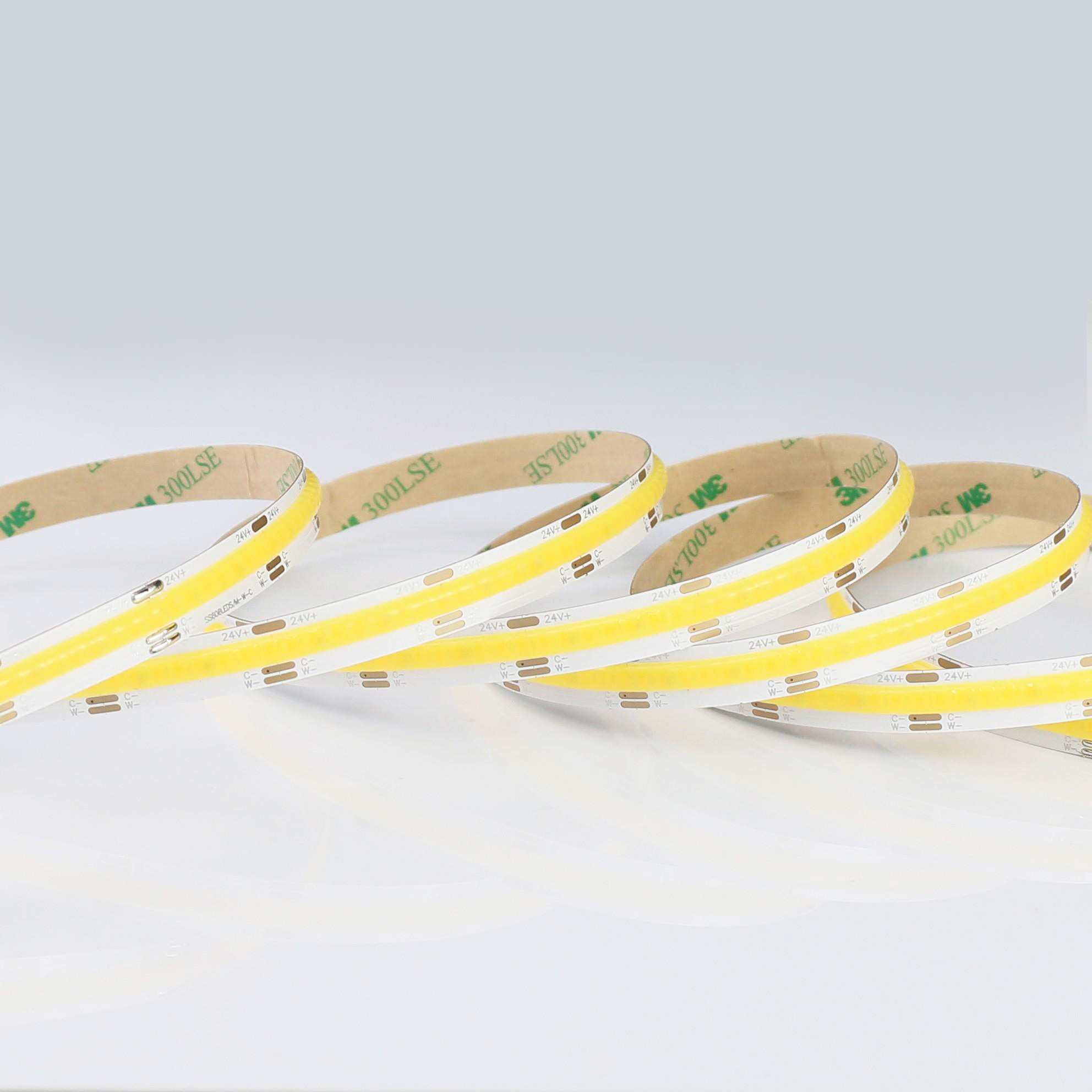
COB LED strip light on the reel. Strip light sold on its own is a light source – the first product category to check against the labelling rules.
Old scale versus new scale: what your stock actually becomes
The most common question from buyers is arithmetic, not legal: “my old sheet said A++, what does it say now?” There is no universal conversion table, because the class is calculated from measured data (luminous flux, on-mode power and other parameters per the regulation’s formula), not from the old class. But the direction and rough magnitude are well understood across the retail market:
| Old label (pre-2021) | Typical new class (2021 scale) | What it means in practice |
|---|---|---|
| A+++ | around D | The old top class sits mid-scale now |
| A++ | around E | Most mainstream LED bulbs land here |
| A+ | around F | Efficient but no longer “top” |
| A | around G | Still legal, bottom of the new scale |
| B to E | below G / off-scale | Many were phased out by ecodesign rules |
Treat this table as orientation, not law. The letter on a real product comes from its measured efficiency index, and two lamps with the same old class can rescale differently. If a supplier offers you a “conversion sheet” that promises A++ always becomes E, that is a sign the paperwork is decorative rather than measured.
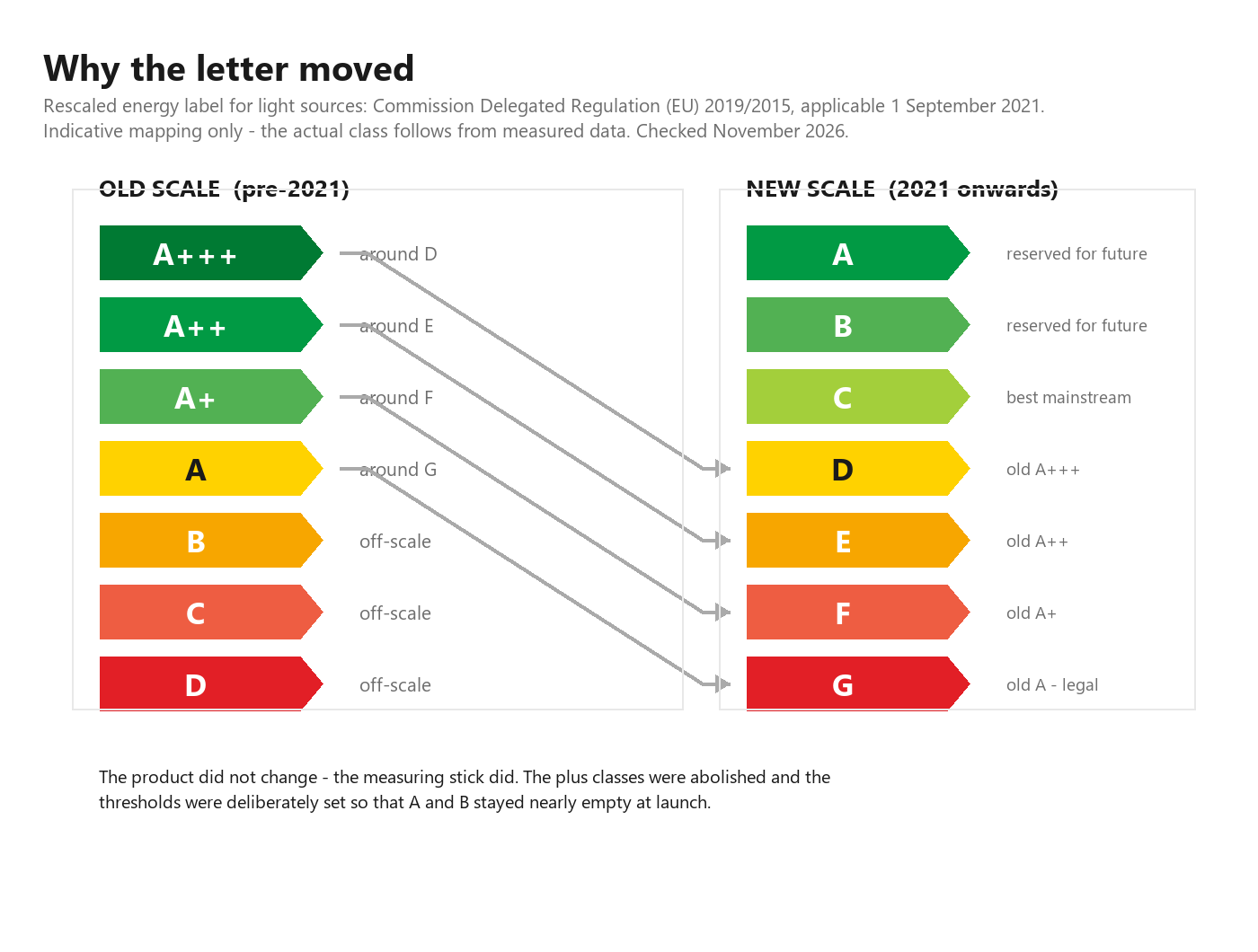
Why the letter moved: the scale was rescaled from A+++…D to A…G with deliberately stricter thresholds. A and B were left nearly empty at launch, reserved for future technology.
Reading the rescaled label
The new label is a compact document, and every element on it earns its place. A compliant label for a light source carries:
- The supplier’s name and the model identifier – the pair that ties the physical product to its database entry.
- The A-to-G scale with an arrow marking the product’s class.
- Energy consumption in on-mode, in kWh per 1,000 hours – the most practical number on the sheet, and the one worth comparing across offers.
- A QR code linking to the product’s entry in the European Product Registry for Energy Labelling (EPREL).
- The regulation number “2019/2015” printed on the label itself.
The QR code is the part buyers underuse. Scanning it takes you straight to the official registry entry, where the declared luminous flux, colour temperature, cap type and other parameters are published. Cross-checking the QR entry against the datasheet you were sent takes a minute, and a mismatch between the two is one of the fastest ways to discover that a supplier’s paperwork does not describe the product in the box.
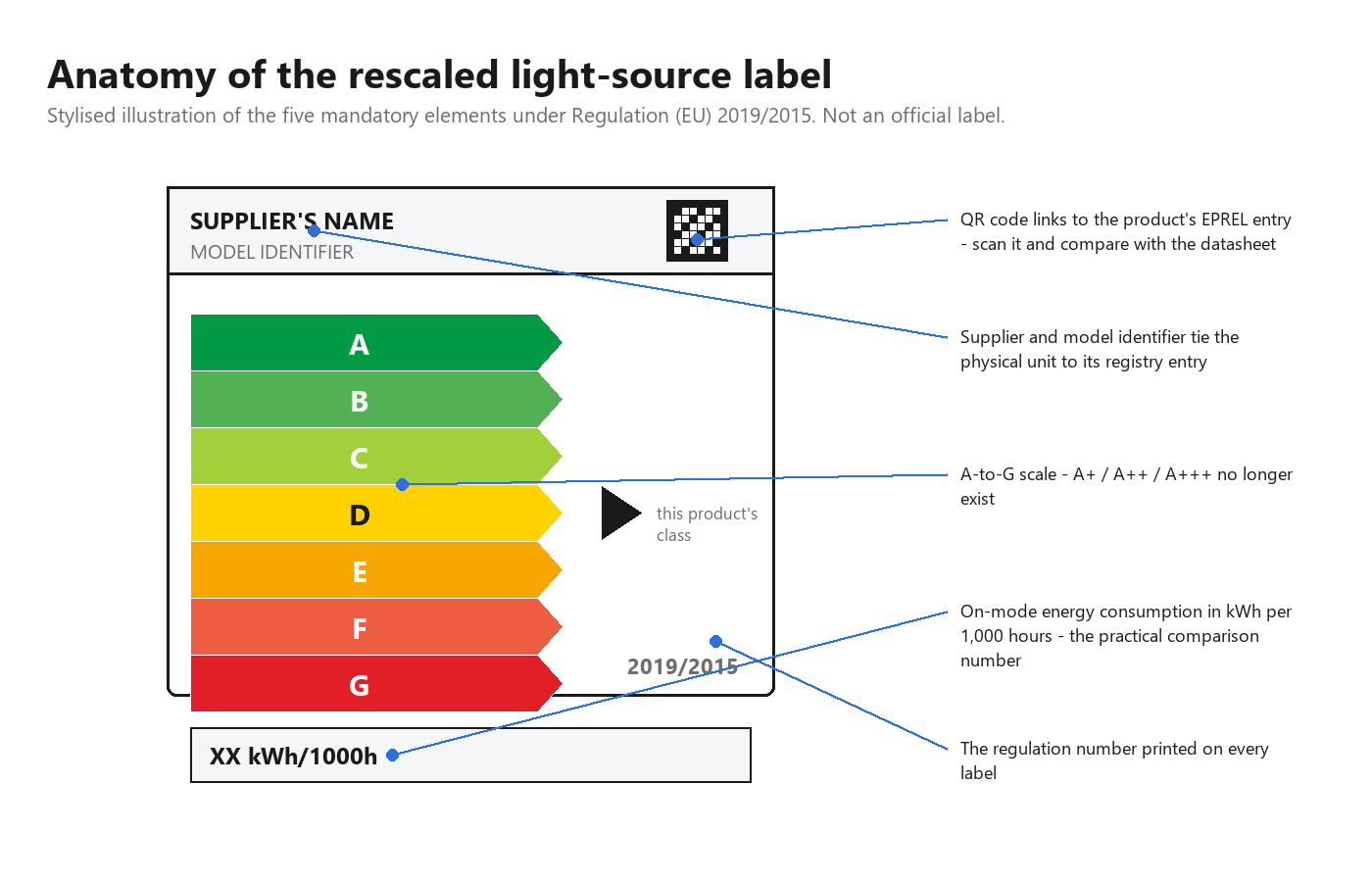
The five elements every rescaled light-source label carries. The QR code is the quickest integrity check: scan it and compare the registry entry with the datasheet in your inbox.

An RGB COB strip light lit up: same lamp, same lumens, same watts – only the letter on the label changed in 2021.
EPREL: registration before the market, not after
The framework regulation (EU) 2017/1369 made registration in EPREL a condition of placing a labelled product on the EU market. In plain terms: no registration, no legal sale in the EU, no valid QR code, and no way for a distributor to meet its own display obligations.
The mechanics matter for anyone sourcing outside the EU:
- The “supplier” who registers is the manufacturer established in the EU, or the importer, or an authorised representative acting for them. A non-EU manufacturer cannot simply open an EPREL account and register its own models; the registration runs through an EU-based entity – typically the importer or the appointed authorised representative (the same “EU responsible person” role that GPSR made famous).
- Registration happens before the product is placed on the market, not after the first shipment lands.
- Distributors do not register; they rely on the supplier’s entry and carry display obligations instead – showing the label at point of sale and making the product information sheet available.

A model identifier on a real datasheet: the CLRGB-COB-576, a 12V/24V 14W RGB COB strip. This identifier is what must match the EPREL registry entry, label and packaging.
Light source, luminaire, or containing product?
This is the distinction that causes the most confusion – and the most wrongly ordered artwork.
Light sources sold on their own (LED bulbs, tubes, modules, strip light sold by the reel) are squarely in scope and need the label and EPREL registration.
Luminaires – finished fittings like a floodlight or a pendant – are a different story. The separate energy label for luminaires was discontinued back in December 2019: there has been no obligation to label a luminaire as such since then. But the regulation adds a twist: a luminaire can itself meet the definition of a “light source” – typically when the light source inside cannot be taken out and verified separately. In that case the whole fitting is treated as a light source and must be labelled and registered accordingly.
Containing products (products that contain a light source, such as furniture with integrated lighting) must not display an energy label of their own; the obligations instead run to the light source inside. Ordering label artwork without knowing which of these three categories your product falls into is how mislabelled shipments happen.

An integrated-LED floodlight: if the light source cannot be removed for verification, the fitting may itself be treated as a light source. This is a case-by-case determination worth confirming in writing.
What sits outside the scope
Not everything that emits light needs a label. The regulation’s exclusion list – set out in its Annexes – typically takes products like these out of scope, and they map directly onto real catalogue lines:
- Products operating exclusively on batteries – including solar-powered string lights and USB-charged portable lamps.
- Light sources in toys.
- Light sources intended exclusively for emergency lighting and similar special-purpose applications.
- Bare LED chips and LED packages – components rather than light sources.
A solar string light that charges itself by day and runs from its own battery at night, or a rechargeable table lamp topped up over USB, generally sits outside the labelling scope. That is genuinely good news for product developers – but it is a determination to make per model, against the regulation text, not a rule of thumb. Marketplaces have been known to ask for energy documentation even on exempt products, so keep the reasoning documented.
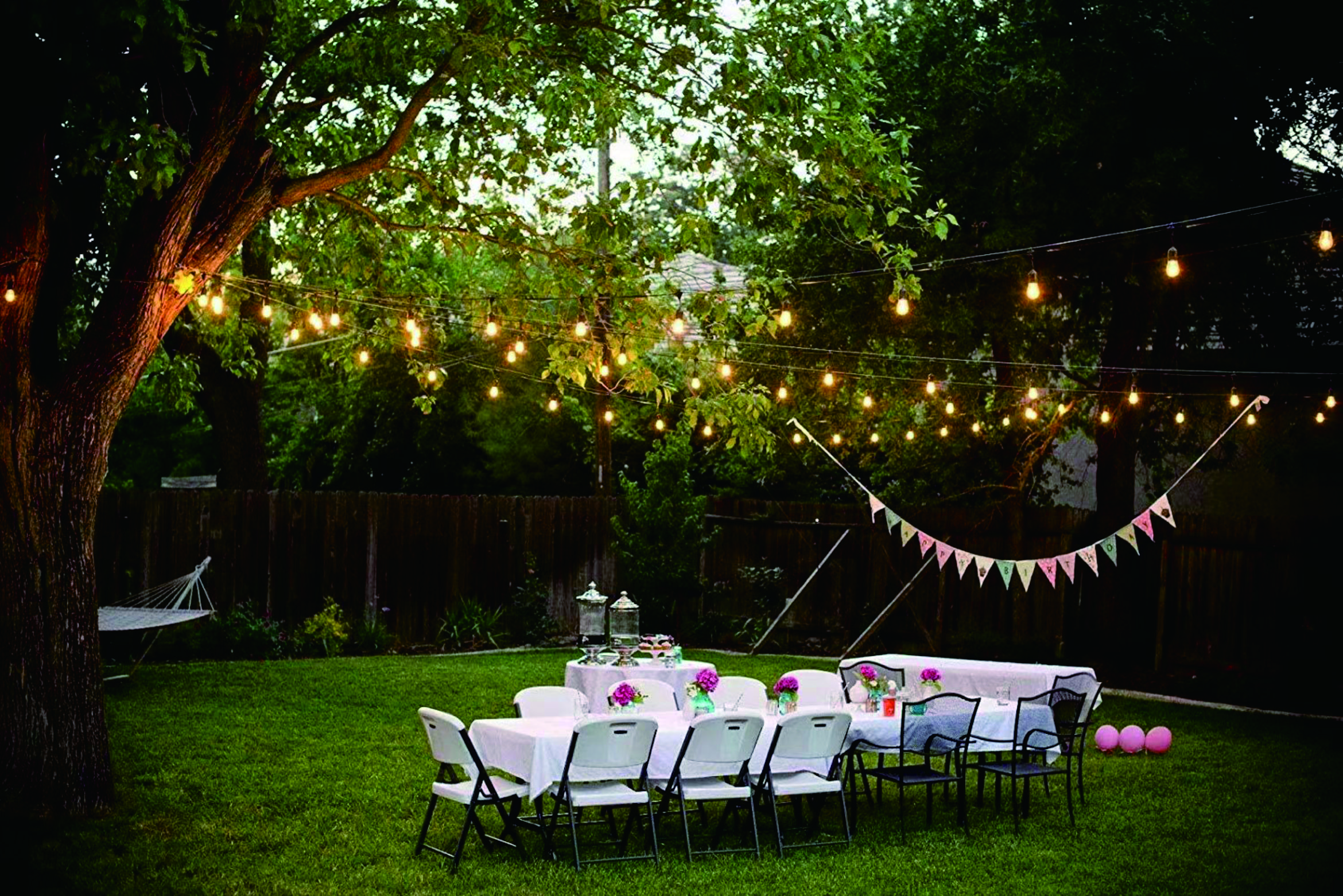
String lights like these solar models are battery-operated products – typically outside the labelling scope. The exemption is per-model and worth documenting, because marketplaces sometimes ask anyway.
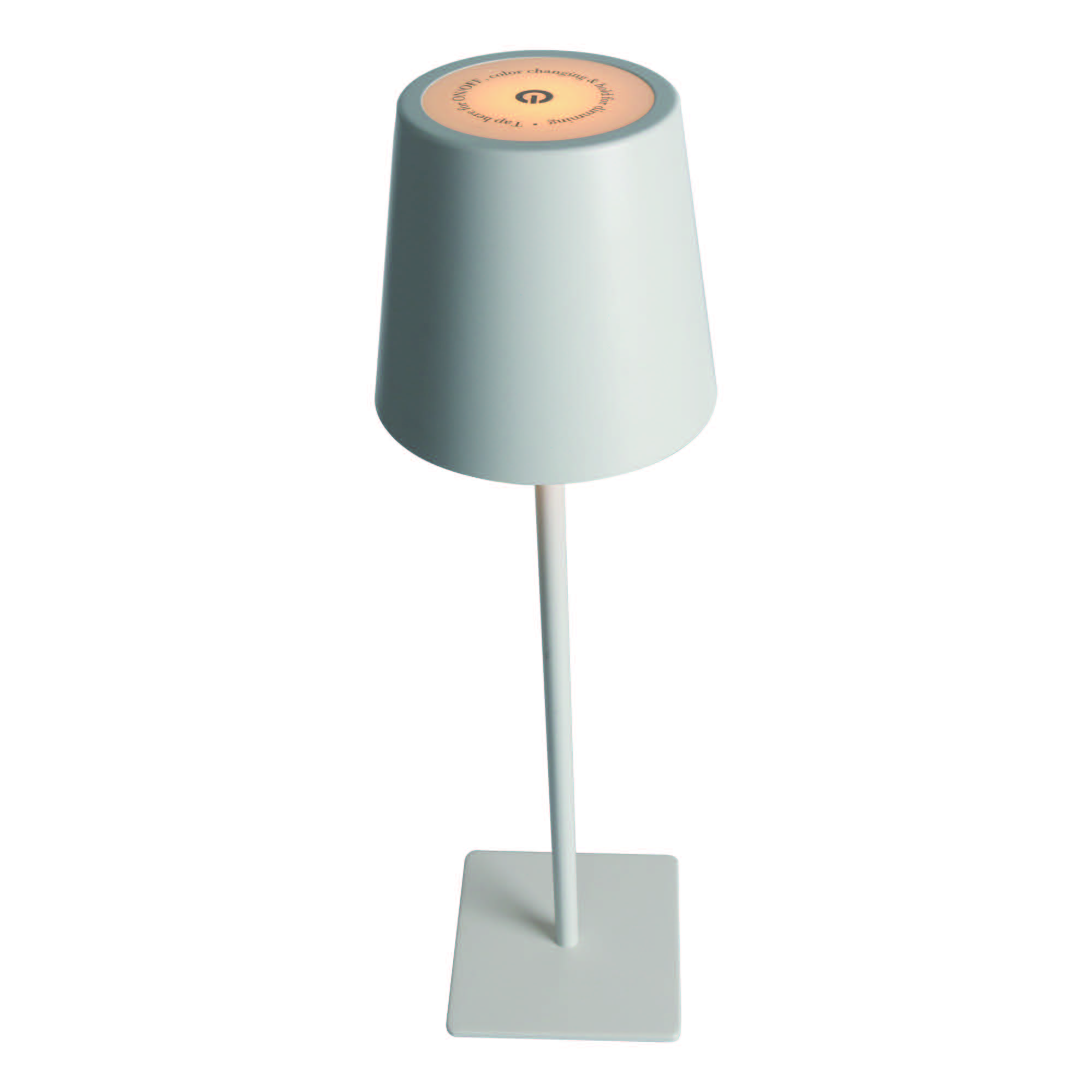
The ZT-001 rechargeable table lamp, charged over USB: battery operation is the typical route out of the labelling scope. Confirm per model rather than assuming.
Old stock, old artwork, old claims
Three housekeeping rules keep legacy material from biting you:
- Old-scale labels are dead. The sell-through window for old-labelled stock closed years ago; any unit still showing A+ or A++ on its packaging in the EU is non-compliant today.
- Old claims outlive old labels. Marketing copy, catalogues, marketplace listings and spec sheets are often the last place “A++” survives. Sweep them the way you would sweep a RoHS claim from a pre-2019 datasheet.
- Do not re-export the confusion. If you buy from a supplier whose paperwork still says A+, ask for rescaled documents – or assume the supplier’s compliance chain stopped updating in 2020, which is useful information about the rest of their paperwork too.
The UK: same letters, different paperwork
Buyers shipping to both markets often assume the UK label is identical to the EU’s. The letters are the same; the paperwork is not.
Great Britain implemented equivalent rescaled requirements through the Ecodesign for Energy-Related Products and Energy Information (Lighting Products) Regulations 2021, which came into force on 1 October 2021 – one month after the EU’s September date. The technical thresholds are equivalent, but three differences matter operationally:
- The GB label carries the Union flag, not the EU flag – a separate artwork file from the EU label.
- There is no GB equivalent of EPREL. The GB regime relies on a publicly accessible website rather than a product database; there is no QR-linked registry entry to check.
- Conformity is demonstrated using designated standards published for GB, which may differ in status from the EU harmonised standards list.
Northern Ireland is the exception: under the Windsor Framework it follows EU rules, so EU labels and EPREL registration apply there. A single UK shipment without deciding the GB/NI question first is one of the classic mixed-up-paperwork cases – the same trap the UKCA/CE split created elsewhere, which we covered in an earlier article on UKCA versus CE.
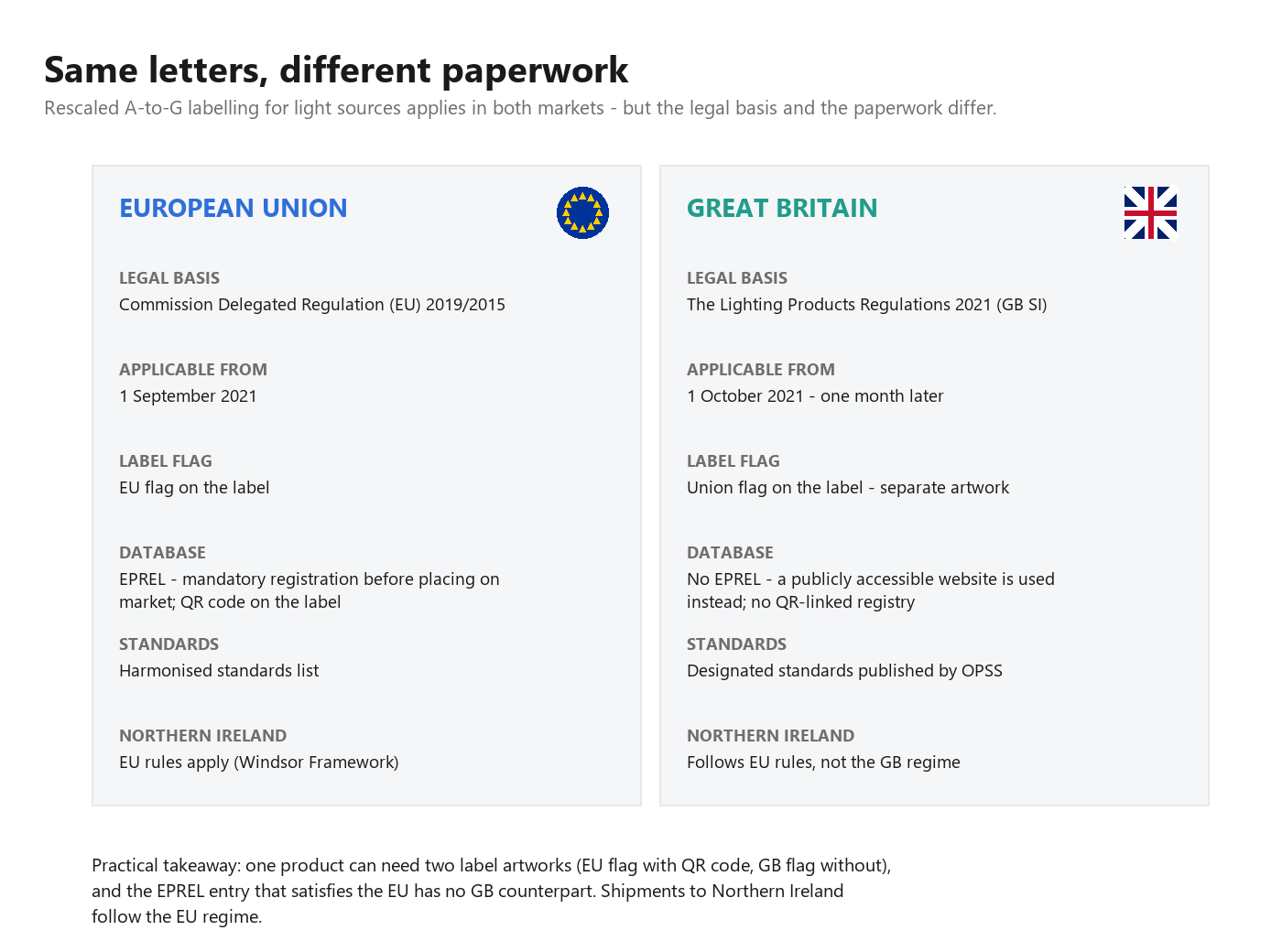
EU versus GB labelling at a glance: equivalent thresholds, but a Union flag on the GB label, no EPREL database in GB, and Northern Ireland following EU rules.
What to ask your supplier – in writing
A short checklist that converts everything above into RFQ language. Five questions, all answerable by a competent supplier within days:
| # | Question | What a good answer looks like |
|---|---|---|
| 1 | Is this model a light source, a luminaire treated as a light source, or a containing product? | A direct category answer, with the reasoning |
| 2 | What is the EPREL registration number, and what is the public URL? | A number and a working eprel.ec.europa.eu link |
| 3 | Is the model in scope at all, or exempt (battery-operated, special purpose)? | A written exemption analysis, per model – not “usually exempt” |
| 4 | Can you supply both EU and GB label artwork? | Two files: EU flag with QR code, GB flag without |
| 5 | Which measured report does the declared class come from? | A test report reference, not just a letter on a drawing |
Question 3 is where new buyers lose the most time. If a model is genuinely exempt, there is nothing to register and the label disappears from the packing list – and discovering that late, after artwork is printed, is an expensive lesson.
How this maps to a real catalogue
The three categories above are not abstract – most lighting catalogues span all of them. Strip light sold on the reel is the textbook light-source case: models such as the CLRGB-COB-576 and CLCCT-COB-624 are 12V/24V strip products whose labelling treatment should be confirmed against the regulation’s scope before artwork is ordered. Finished fittings such as floodlights sit in the luminaire-versus-light-source analysis described above. And the battery-operated end of a range – solar string lights like the LPL-S-10-S45 or the ZT-001 rechargeable table lamp – typically falls outside the scope entirely, which changes what paperwork your retail customers need from you.

A dual-colour COB strip on the reel: light-source, luminaire-treated-as-light-source, or exempt – the answer is per model.
This sits alongside the compliance topics we have covered in this series: the 2027 battery regulation deadline for rechargeable LED lamps, GPSR obligations for EU importers, and how to read a floodlight datasheet without getting fooled by declared numbers. Energy labelling joins them as the fourth pillar of the paperwork pack a serious buyer assembles before issuing a purchase order.
The full strip light range lives in our LED strip lights category, and the rechargeable lamp range in rechargeable table lights. If you are consolidating a range for the EU and GB markets and want the labelling treatment confirmed per model, ask – the honest answer, including “this one is exempt and needs no label”, is more useful than a wall of letters.
Facts in this article were checked against European Commission and UK legislation sources in November 2026. Indicative class mappings are drawn from public retail guidance; actual classes follow from measured test data. Nothing here is legal advice – where the scope of a specific model is unclear, the determination should be made against the regulation text with your authorised representative or market surveillance authority.
about
Symbol Industrial
Supplier of outdoor lightings and electric products in China.