

A container leaves Ningbo with one plug type fitted to every unit in it. Six weeks later a distributor in Rotterdam, or a wholesaler in Manchester, opens the cartons and finds that a third of the order will not go into the wall. Nothing was defective. Nothing failed inspection. The plug was simply built to the wrong country’s standard, and nobody in the chain had written the standard down.
This is one of the few remaining categories of loss in the lighting and electrical trade that is entirely avoidable and still entirely common, because “European plug” sounds like a specification and is not one. Europe runs five incompatible plug families across its main markets, and two of them contain a trap that passes normal quality control without a murmur: the plug fits the socket, the product works, and a safety function is silently absent.
What follows is a buyer’s map. Not a travel guide – the audience here is the importer writing an RFQ, the product manager building a range, and the QC inspector opening a carton at the factory. The question we are answering is narrower and more useful than “which plug does country X use”: it is what has to be specified, and what goes wrong when it is not.
“European plug” is not a specification
Start with the number of variables. A plug has a pin geometry, a pin spacing, a current rating, an earthing method and, in one market, a fuse. Change any one and you have a different part number. Five markets, five different answers, and only two of the five are genuinely interchangeable with each other.
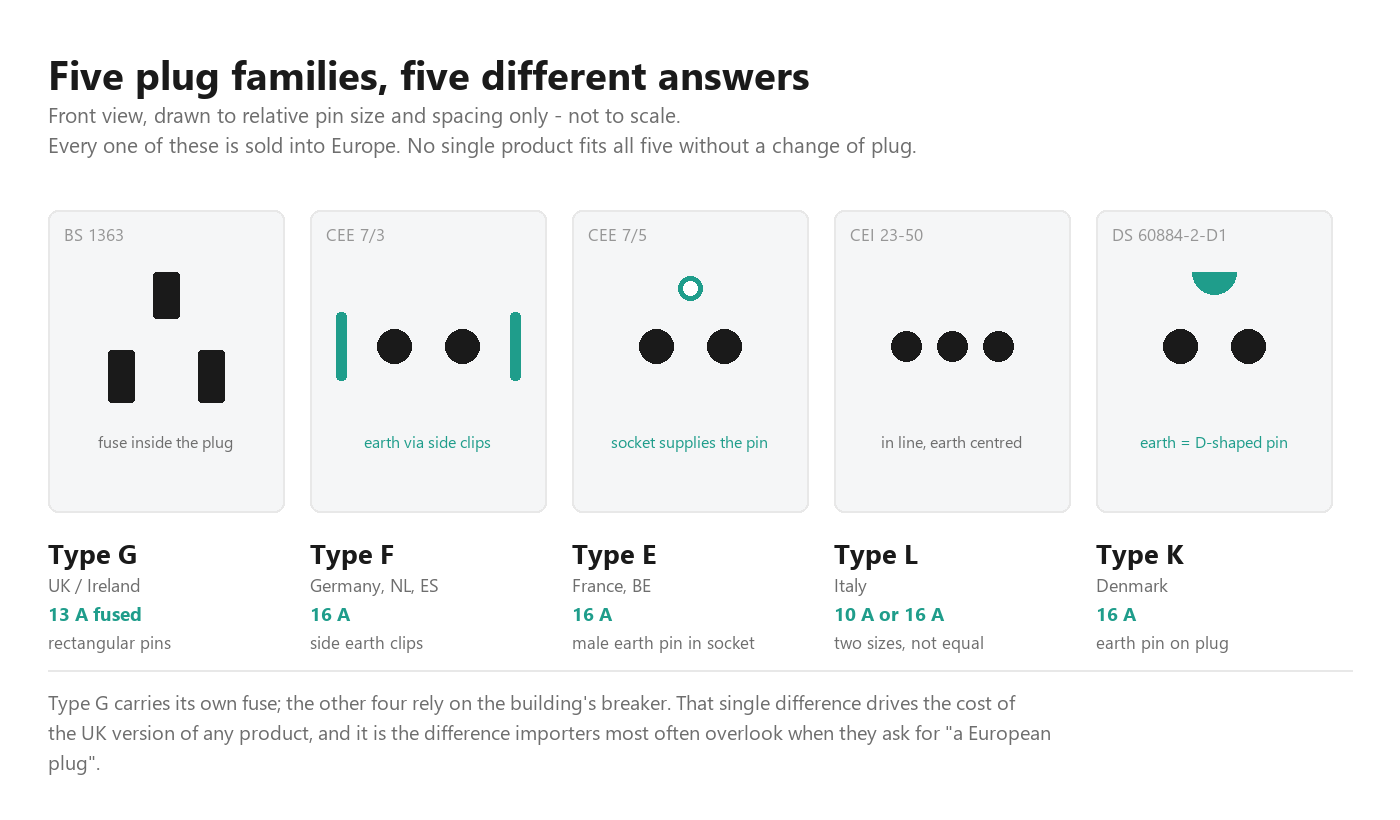
The five families a European range has to cover. Drawn to relative pin size and spacing; not an engineering drawing.
| Market | Standard | IEC type | Rating | Earth contact | Fuse in plug |
|---|---|---|---|---|---|
| UK, Ireland | BS 1363 | Type G | 13 A | Pin, longest of the three | Yes, BS 1362 |
| Germany, Netherlands, Spain, Portugal | CEE 7/3 | Type F (Schuko) | 16 A | Clips on the socket | No |
| France, Belgium | CEE 7/5 | Type E | 16 A | Pin on the socket | No |
| Italy | CEI 23-50 | Type L | 10 A or 16 A | Pin, in line with L and N | No |
| Denmark | DS 60884-2-D1 | Type K | 16 A | Pin on the plug | No |
Read the last two columns together and the commercial consequence appears. The UK version of any product needs a fuse inside the plug, a fuse carrier, and a plug body that survives the testing that goes with a fused design. The other four need none of that. A single BOM cannot serve all five markets at one price, and a quotation that offers “EU and UK plug options” at the same unit cost is either absorbing the difference somewhere or has not understood it.
Who brings the earth contact
The column most buyers skim is the earth contact, and it is the one that decides whether a product is safe in the market it lands in. The question is not whether a plug has an earth pin. It is which side of the interface the earthing part is mounted on – the plug or the socket.
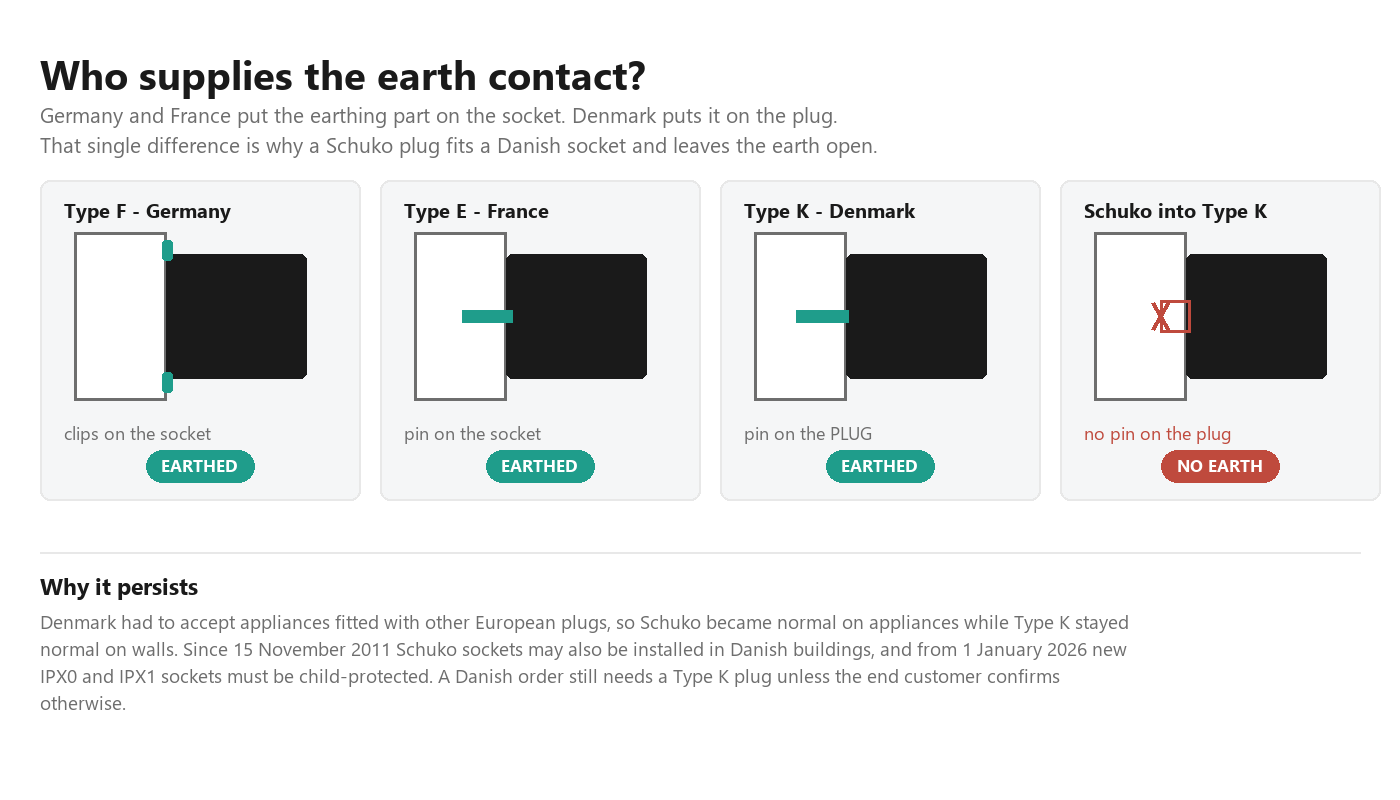
Three European standards, three different answers to the same question. The fourth panel is what happens when they are mixed.
In Germany the socket carries two spring clips that grip the sides of the plug. In France the socket carries a protruding male pin that enters a hole in the face of the plug. In both cases the socket supplies the earthing part and the plug only has to present a surface or a hole for it to meet. Denmark inverts this: the plug carries a D-shaped earth pin which enters a recess in the socket.
The consequence is not subtle. A Schuko plug enters a Danish Type K socket, seats fully, and powers the appliance. It also leaves the earth connection open, because the socket is waiting for a pin the plug does not have. The appliance runs, the user notices nothing, and a fault that the earth was supposed to clear now has a path through whoever is holding the appliance.
The UK: the plug contains a fuse
The British plug is the only one in this group with a protective device inside it, and that changes the product, not just the plug top.
BS 1363 specifies a 13 A plug containing a BS 1362 fuse, with the line and neutral pins part-insulated at the base so that a partially withdrawn plug cannot be touched live. The socket has shutters that open only when the longer earth pin enters first. Those two features – the fuse and the shutter interlock – are why the British plug has a reputation out of proportion to its size, and why it cannot be substituted with a moulded European plug plus a travel adapter.
The legal position is explicit. Regulation 12 of The Plugs and Sockets etc. (Safety) Regulations 1994 prohibits supplying an appliance unless it is fitted with a standard plug conforming to BS 1363, fitted with a fuse link conforming to BS 1362 and rated to the manufacturer’s instructions. The narrow exception is an appliance fitted with a non-UK plug meeting IEC 884-1 and a conversion plug that encloses it and can only be removed with a tool. A loose adapter in the box does not qualify.
There is one inspection point worth carrying in your head, because it catches counterfeits faster than any document check. BS 1363 is a national standard and the regulations are national in origin, so CE marking should not appear on a BS 1363 plug at all. The Institution of Engineering and Technology states plainly that a CE mark on a plug claiming to be made to BS 1363 is itself a reliable indication of a counterfeit; the marks that should be there are the approval marks of a notified body – BSI’s Kitemark, ASTA’s Diamond Mark, or Nemko’s N mark, with a licence number.
If you are importing into the UK and want the wider picture on marking and market access, we covered the current UKCA and CE position in a separate article: UKCA or CE in 2026: what UK buyers should ask a lighting supplier. The short version relevant here is that the plug question is decided by the 1994 Regulations, not by whichever conformity mark the carton carries.

A five-gang BS 1363 extension socket – model 67015. Every outlet is switched and individually indicated; the BS 1363 plug on the supply end carries its own fuse.
The Italian trap: two sockets with one name
Italy is where the most expensive mistakes happen, because the two variants do not look different at a glance and cannot be converted after the plug is moulded.
CEI 23-50 – formerly CEI 23-16/VII – defines a 10 A plug and a 16 A plug. Both are three round pins in a straight line with the earth in the middle. Both are unpolarised, so they go in either way round. They differ in pin diameter and pin spacing: the 10 A version has 4 mm pins at 19 mm centres, the 16 A version has 5 mm pins at 26 mm centres.
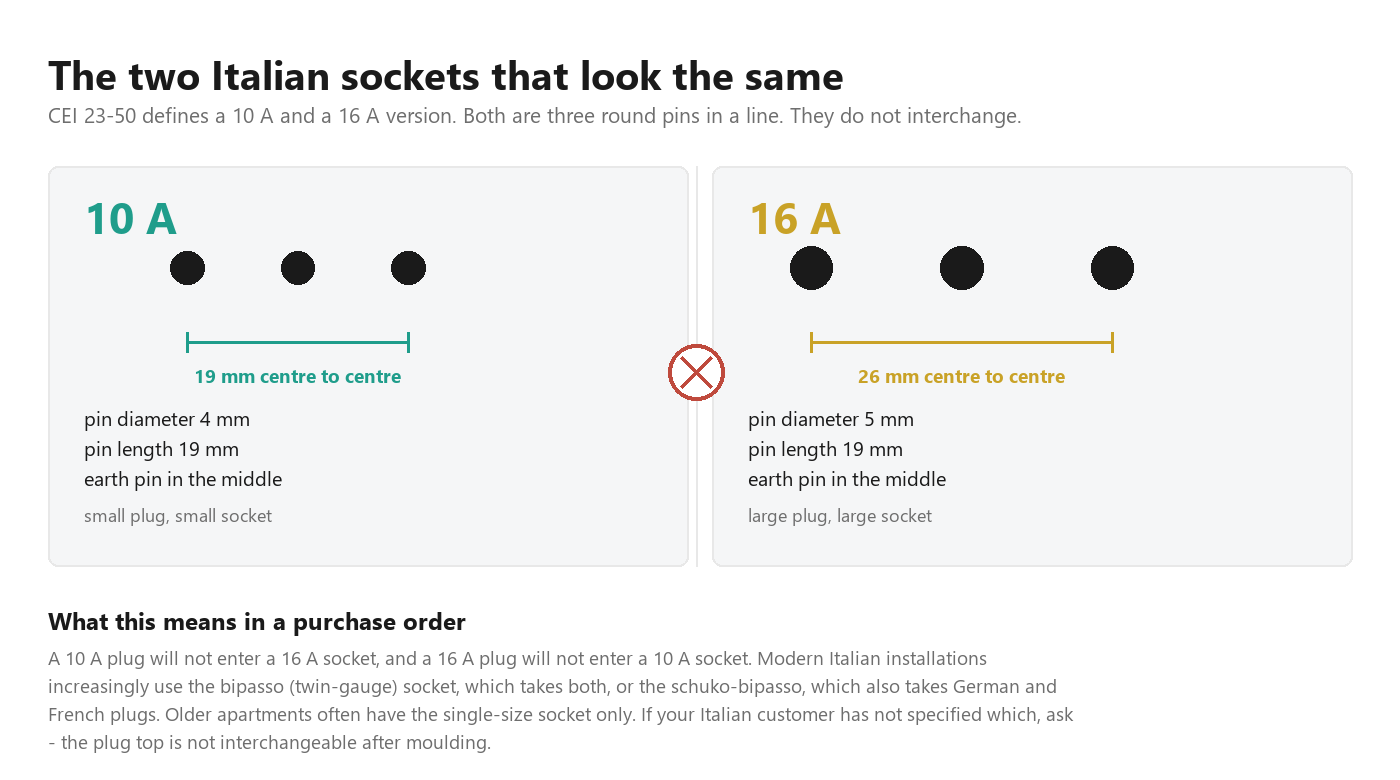
Same layout, different dimensions. A 16 A plug will not enter a 10 A socket, and a 10 A plug sits loose in a 16 A socket.
Neither is a superset of the other. The 10 A plug will not enter a 16 A socket because the pins are too close together; the 16 A plug will not enter a 10 A socket because the pins are too far apart. A 16 A plug is not “better” – for a lamp or a charger it is simply the wrong part.
Two socket designs soften this in practice. The bipasso (twin-gauge) socket accepts both plug sizes and the two-pin Europlug; the schuko-bipasso additionally accepts German and French plugs. Newer Italian installations lean toward the twin-gauge designs, and older apartments often have the single-size socket only. That is why the question to your Italian customer is not “which plug” but “16 A or 10 A, and is the socket bipasso?” – and why the answer has to arrive before the moulding tool is cut.
Denmark: it fits, and it does not earth
Denmark deserves its own section because the failure mode here is invisible.
DS 60884-2-D1 – DS 107-2-D1 in the older numbering, Type K in IEC terms – is rated 16 A at 250 V. Its power pins are 4.8 mm round and 19 mm long, at 19 mm centres: dimensionally close enough to Schuko that a German plug slides in without resistance. The earthing pin is the difference. It is D-shaped, 14 mm long, 4 mm thick, 6.5 mm in diameter, and offset 13 mm from the line joining the two power pins – and it lives on the plug, not the socket.
The history explains the situation. Denmark was required under European internal-market rules to stop insisting that imported earthed appliances be fitted with a Danish plug. Schuko subsequently became normal on appliances while Type K remained normal on walls. French-style CEE 7/5 sockets have been permitted in Danish buildings since 2008 and Schuko sockets since 15 November 2011, but Type K is still by far the most common socket in Danish homes. From 1 January 2026, new sockets rated IPX0 and IPX1 must also be child-protected – a tightening that affects any socket you ship into the Danish market this year.
So the Danish SKU needs a Type K plug unless the end customer explicitly confirms otherwise, and “the German version will do” is the sentence that turns a compliant order into a liability.
France and Germany: the one genuinely interchangeable pair
The CEE 7/7 plug is the exception that makes the German-French corridor workable: it carries both a hole in its face for the French socket’s male earth pin and side surfaces for the German socket’s clips. One part number covers Germany, France, Belgium, the Netherlands, Spain and Portugal, which is why a single “EU plug” is defensible for those markets – and only those.
Two cautions. A pure CEE 7/3 Schuko plug entering a French Type E socket makes mechanical contact but no earth, because it has no hole for the socket’s pin; likewise a pure CEE 7/5 French plug entering a Schuko socket has a hole with nothing to meet. Only the combination plug earns the word “interchangeable”. And none of the three works in Denmark, for the reason set out above.

AS-GB06S: six Schuko outlets, one on-off switch, H05VV-F cable in 3×1.5 mm² up to 30 m or 3×1.0 mm² up to 2 m.
Where the cable becomes the binding constraint
Once the plug is settled, the part that decides whether the product survives its warranty is behind it. Two numbers on our own German range illustrate how much sits behind a gang count.
| Model | Outlets | Cable | Maximum length | Extra |
|---|---|---|---|---|
| AS-GB06S | 6 × Schuko | H05VV-F 3×1.5 mm² | 30 m | 3×1.0 mm² version limited to 2 m |
| AS-GB06S-USB/C | 6 × Schuko | H05RR-F 3×1.5 mm² | 30 m | 1 USB-A, 1 USB-C |
| AS-DY06K | 6 × Schuko | H05VV-F 3×1.5 mm² | 30 m | Surge and overload protection |
| 8316 | 6 × BS 1363 | H05VV-F 3×1.5 / 1.25 / 1.0 mm² | – | Independent switches, indicators |
| U8316 | 6 × BS 1363 | H05VV-F 3×1.5 / 1.25 / 1.0 mm² | – | 2 USB-A, 1 USB-C |
The point of that table is not the gang count. It is that the same six-gang body is published with two different cable compounds – H05VV-F, a PVC-insulated flexible cord, on the switched version, and H05RR-F, a rubber-insulated cord, on the USB version. Those are not interchangeable in a quotation: rubber cord costs more, tolerates flexing and low temperature better, and behaves differently on the flammability tests. If your RFQ says “six-gang German socket, 1.5 mm cable”, two suppliers can quote compliantly and deliver different products.
The 30 m ceiling on the 1.5 mm² version, and the 2 m ceiling on the 1.0 mm² one, are the other number worth reading twice. Both reflect voltage drop and conductor heating over length at the rated current, not a manufacturing limit. A customer who asks for a 20 m lead on 1.0 mm² is asking for something that should not be quoted, and the supplier who quotes it without comment has just told you something about how the rest of the specification was treated.

AS-DY06K: the same six-gang Schuko format with surge protection and overload protection added – the version that goes into office and workshop enquiries.

AS-GB06S-USB/C: six Schuko outlets plus one USB-A and one USB-C. Note the H05RR-F rubber cord, where the switched version uses PVC.
What a mixed container really costs
Three costs follow from getting this wrong, and only the first is obvious.
The rework cost is a plug change at destination: labour, new plugs, retest, repack. On a 5,000-piece order of extension leads this is not a rounding error, and it happens after freight has been paid twice.
The certification cost is worse. A plug change moves the product into a different test scope. The UK version needs a fused plug with the correct BS 1362 rating and the approval-mark regime that goes with it; a Danish version needs a Type K plug that a notified body has seen. Re-testing a product because the plug was wrong is a full cycle, not a supplement.
The relationship cost is the one that does not show in a spreadsheet. An importer who receives a container of plugs that do not fit their market does not conclude that a specification was ambiguous. They conclude that the supplier does not know the market, and they place the next order with someone who does.
The RFQ, in eleven lines
If this article has one practical output, it is this list. Copy it into the specification section of your next enquiry and most of the risk above disappears before a quotation is issued.
- Destination country, and the plug standard by name – BS 1363, CEE 7/3, CEE 7/5, CEI 23-50 or DS 60884-2-D1. Never “EU plug”.
- For Italy: 10 A or 16 A, and whether the socket is bipasso.
- For the UK: fuse rating required, and whether an approval-marked plug is mandatory for your channel.
- For Denmark: confirmation that Type K is required, in writing.
- Number of outlets, and whether each is individually switched.
- Cable compound – H05VV-F, H05RR-F or other – and conductor cross-section.
- Required lead length, with the current rating at that length.
- Earth continuity requirement and the test applied to it.
- Surge or overload protection, if required.
- USB output specification if fitted: port count, protocol, and total output.
- The standard the finished assembly is declared to, and who holds the test report.
Line 11 is the one that separates a supplier from a trading company. A factory that builds to a named standard can tell you which clause its design follows; a trader forwards your question to someone else.
Where our own range sits
We build both corridors described above. The UK type extension socket range covers BS 1363 assemblies from two to six gangs, with switched, indicated, surge-protected and USB/Type-C variants – for example the six-gang 8316 and the six-gang U8316 with USB and Type-C. The German extension socket range runs the same gang counts on Schuko, from the three-gang AS-GB03S to the eight-gang AS-GB044S, including the surge-protected six-gang AS-DY06K and the USB/Type-C version.
Between the two plug families sits a small category that exists purely because of the mismatch this article is about: the CEE-to-BS adaptor range, for site and event work where 16 A CEE outlets have to feed 13 A British equipment – such as the GX01E, 16 A CEE plug to a single 13 A BS socket.

U8316: six BS 1363 outlets with independent switches and indicators, plus two USB-A and one USB-C port, on H05VV-F cable.
If you are also specifying outdoor luminaires alongside these, two of our earlier guides cover the parts of the specification that behave the same way – a number that looks sufficient until you know what it excludes. IP65, IP66 or IP67 explains what the two digits actually promise, and how to read an LED floodlight datasheet applies the same interrogation method to lumens, power factor and lifetime that this article applied to plugs.
The one line to remember
A plug standard is not a regional variant of a universal part. It is a specification with a current rating, an earthing method and, in one country, a fuse – and two of Europe’s five families will physically accept a plug that leaves the earth open.
Write the standard by name in the RFQ. Ask the 10 A or 16 A question in Italy. Get Denmark confirmed in writing. Everything after that is manufacturing.
If you are building a range across these markets and want the plug and cable combinations laid out against your actual destination list, send us the list – we will tell you which of the five you need and which of them we would not combine in one SKU.
about
Symbol Industrial
Supplier of outdoor lightings and electric products in China.
blog tags
related posts

October 27, 2026