
The IP number is the most quoted and least understood line on an outdoor lighting datasheet. Buyers use it as a shorthand for quality, suppliers escalate it to win comparisons, and both sides often end up arguing about a figure that does not describe the thing that actually fails in service.
Here is what the rating means, what it does not cover, and how to write a specification that a factory can quote against without ambiguity.
What the two digits mean
IP ratings come from IEC 60529. The first digit is protection against solid objects, the second against water. The levels you will meet on outdoor lighting:
| Code | Solids | Water |
|---|---|---|
| IP44 | Objects over 1 mm | Splashing water from any direction |
| IP54 | Dust protected (limited ingress) | Splashing water from any direction |
| IP65 | Dust tight | Water jets from any direction |
| IP66 | Dust tight | Powerful water jets |
| IP67 | Dust tight | Temporary immersion, typically 30 minutes at 1 m |
| IP68 | Dust tight | Continuous immersion, conditions agreed between buyer and supplier |
Only 6 on the first digit means genuinely dust tight. A product advertised as “IP54” is protected against dust ingress, not sealed against it — which matters in a grain store, a sawmill or a fertilizer yard where the question is not whether dust gets in, but how fast.
Where IP65 and IP66 actually differ
This is the distinction most worth understanding, because the price difference is real.
IP65 is tested with a 6.3 mm nozzle at 12.5 litres per minute. IP66 uses a more aggressive test: a 12.5 mm nozzle at 100 litres per minute, which is closer to what a pressure washer delivers. If your installation will be washed down — food processing, agricultural buildings, vehicle depots, marine yards — IP66 is not marketing, it is the difference between a fixture that survives its first hose-down and one that fills with water.
IP67 goes further and covers brief immersion, which is the right answer for a fixture set in a drainage channel, a fountain surround or a low point that floods.
What IP does not cover
An IP rating says nothing about the following, and every one of them causes field failures:
- Impact. That is IK, tested under IEC 62262, expressed as IK08 to IK10. A high-bay or floodlight on a site with vehicles, or one shipped in a thin carton, needs an IK figure as much as an IP figure.
- Corrosion and salt. Coastal and offshore sites need salt-spray testing to the relevant standard, and a housing material selected for it. An IP66 aluminium body with the wrong paint system will corrode from the outside in.
- UV and ageing. Gaskets and polycarbonate diffusers degrade under UV. A gasket that is watertight in year one can be brittle in year four.
- Temperature and condensation. Sealed housings breathe. A poorly designed fixture with an effective seal but no pressure-equalisation or drainage strategy will collect condensation inside the lens — a defect no IP test catches.
- Installation. The rating applies to a complete, correctly installed luminaire, including the cable gland and the way the supply is entered. A fixture rated IP66 with an unbranded gland fitted at installation, or with the cable entry pointing upward, is not an IP66 installation. This is the single most common cause of a warranty argument that nobody wins.
- Surge. Lightning-adjacent overvoltage is a surge and insulation problem, tested under the applicable immunity standards, not a sealing problem. For sites with long cable runs or overhead supply, specify the surge protection rating in kilovolts rather than hoping.
How to read an IP claim properly
Under IEC 60529, a rating is a test result, not a design intention. So when a datasheet claims IP66, the useful questions are:
- Which laboratory produced the report, and is it accredited for that test?
- Was the test performed on the production design, or on a prototype that later changed?
- Does the report cover the fixture as sold, with the gland and cable entry supplied?
- Is there a report number you can be given?
A supplier who can produce a report number is worth more than one who offers a bigger number than the last supplier. When you evaluate a new source, ask for the report on the first order — how the answer arrives tells you most of what you need to know about the relationship.
Six lines a floodlight specification should state
If you want comparable quotations from three factories, put these in the RFQ rather than letting each supplier choose its own headline:
- IP and IK — for example IP66 / IK09, with test reports to be supplied.
- Ambient operating temperature range, and whether lumen output is quoted at 25 °C or 40 °C.
- Lumen maintenance — L70 or L80 hours, and whether it is supported by LM-80 data with a TM-21 projection, or merely asserted.
- Surge protection — rated in kilovolts, at the specified test waveform.
- Housing and finish — material, coating system, and the corrosion class it is intended for.
- Warranty terms — including what the warranty excludes, and how it behaves in a coastal installation.
Add the mounting arrangement, cable length, connector type and the photometric file format you need, and you will have a document that supports a real comparison instead of a price list.
Then get one unit in one installation, and leave it there through a winter. No datasheet replaces that.
What we build
We produce outdoor lighting in Ningbo for importers, distributors and project buyers, and we will tell you when a rating you have asked for is not the one your application needs. Our LED floodlights range covers site and area lighting, and our garden lighting range covers the residential end of the same question.
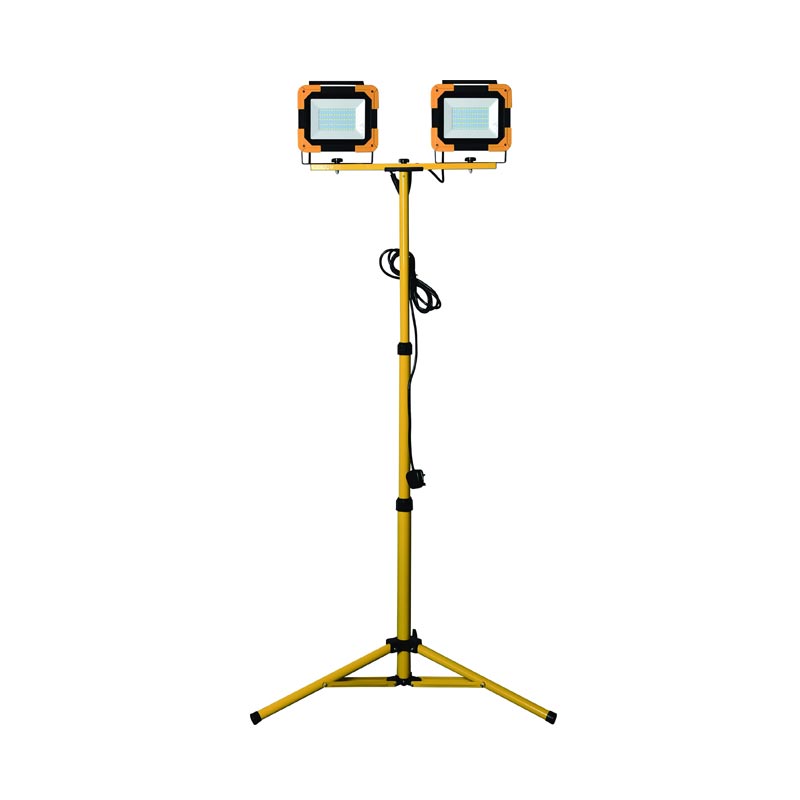
A twin-head tripod floodlight from the range — the kind of product where the ingress question and the mounting question have to be answered together.
Send us the specification lines above, and we will come back with the fixture, the test evidence and the honest limits.
about
Symbol Industrial
Supplier of outdoor lightings and electric products in China.