

Since 28 April 2026, every laptop sold in the European Union has had to charge over a USB Type-C port. That deadline closed the last gap in the EU’s “common charger” rules, and it is worth pausing on what has actually happened: in under two years, a single connector went from being one option among several to a legal requirement across phones, tablets, cameras, headphones, speakers, consoles, e-readers, keyboards, mice – and now laptops.
If you import LED lighting, extension sockets or power accessories into Europe, the direct reach of these rules is narrower than the headlines suggest. A work light is not a smartphone, and the directive says so. But the rules quietly redraw the expectations around everything that sits next to the devices they cover: the extension socket with USB ports that feeds them, the rechargeable lamp that charges from them, and – from December 2028 – the charger hardware itself. Buyers who read the scope precisely are the ones who write better RFQs and avoid the two classic mistakes: assuming the rules cover everything with a battery, and assuming they cover nothing you sell.
What the rules actually are
The legal base is Directive (EU) 2022/2380, which amends the Radio Equipment Directive (RED) 2014/53/EU. It landed in the Official Journal on 23 November 2022, and it adds five requirements – the “common charger requirements” – to a defined list of radio equipment:
- A USB Type-C receptacle as the port for wired charging.
- USB Power Delivery (USB PD) as the charging protocol wherever charging requires more than 15 W.
- A harmonised label (Annex Ia, Part IV) stating the device’s charging capabilities and the chargers it is compatible with.
- A pictogram (Annex Ia, Part III) declaring whether a charger is actually included in the box.
- Unbundling: the seller may offer the device without a charger, so consumers can buy one only when they need it.
The scope is a closed list, not a general principle. Since 28 December 2024 it has covered handheld mobile phones, tablets, digital cameras, headphones and headsets, portable speakers, handheld videogame consoles, e-readers, earbuds, keyboards, mice and portable navigation systems. Since 28 April 2026 it also covers laptops.
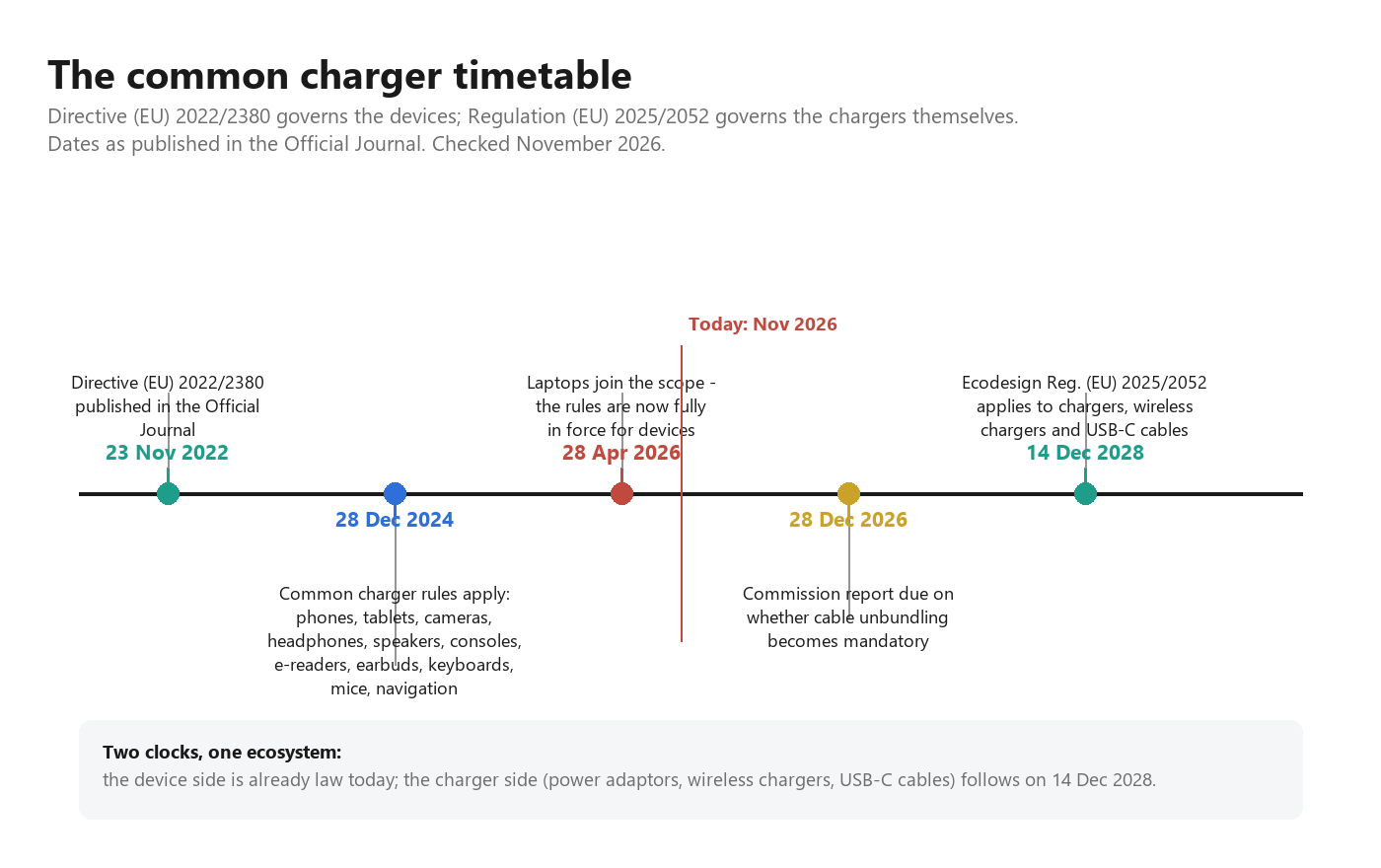
Two clocks run side by side: the device rules are already in force; the charger hardware rules follow on 14 December 2028.
Two details of that list matter more than the rest for B2B buyers. First, USB PD is only mandatory above 15 W – a lamp that tops up a small battery at 5 V 1 A is not dragged into a fast-charging protocol by default. Second, the labelling and pictogram obligations are not decoration: the directive explicitly makes a missing pictogram or label a formal compliance failure that market surveillance can act on.
What is not covered – and why it still matters
Here is the sentence worth writing on the whiteboard: luminaires are not on the list. LED work lights, floodlights, garden lights and table lamps are not radio equipment within the meaning of the common charger requirements, and a rechargeable floodlight does not become covered because it contains a battery. If a supplier tells you a rechargeable work light “must now be USB-C because of EU law”, the law says no such thing about the light itself.
That does not make the rules irrelevant to a lighting order. Three reasons:
- The ecosystem expectation has shifted. After December 2024, European consumers and tradespeople increasingly own USB-C chargers and nothing else. A rechargeable lamp that ships with a proprietary or micro-USB cable now looks dated on a European shelf even where it is perfectly legal. Our own ZT-001-1 rechargeable table lamp – 5 W, 5 V 1 A, a 1,200 mAh lithium battery charging in four hours – ships with a USB Type-C cable in the box, and that is a market-driven choice, not a regulatory one.
- Extension sockets with USB ports feed covered devices. A socket itself is not radio equipment, but the phone, tablet or laptop plugged into its USB ports is. The practical consequence is buyer expectation: ports that only deliver legacy 5 V at low current, or USB-A-only configurations, are increasingly specified against.
- The charger side is coming. From December 2028, the wall charger itself is regulated – more on that below.
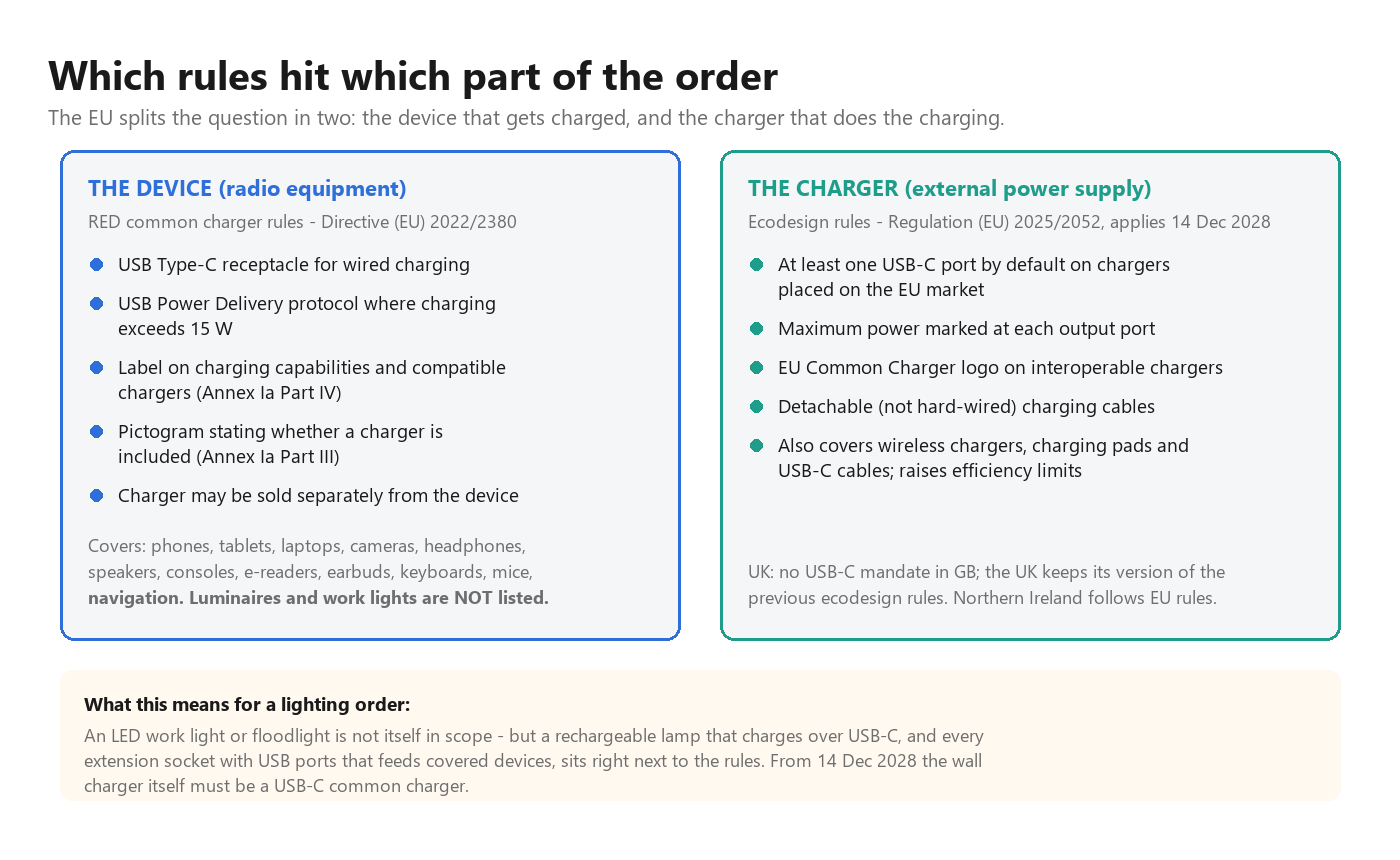
The EU splits the question in two: what the device must have, and what the charger must be. Luminaires sit outside both lists – but next to both.
The charger itself: Regulation (EU) 2025/2052
The directive governs devices; the charger was until recently governed only by an efficiency rule (Regulation (EU) 2019/1782, the ecodesign regime for external power supplies). That changed on 13 October 2025, when the Commission adopted Regulation (EU) 2025/2052, which rewrites the ecodesign requirements for external power supplies, wireless chargers, wireless charging pads, battery chargers for portable batteries of general use – and USB Type-C cables themselves.
The regulation entered into force on 14 December 2025 and applies from 14 December 2028. Its interoperability requirements are the ones that will reshape charger product lines:
- External power supplies placed on the EU market must be “common chargers” – in practice, at least one USB-C port by default.
- The maximum power supported must be marked at each output port.
- Interoperable chargers carry a new EU Common Charger logo.
- Chargers must work with detachable cables, not captive ones.
- Efficiency limits are raised alongside, and the scope extends beyond the old 250 W ceiling.
There is a transitional clause worth knowing: between 14 December 2025 and 14 December 2028, products that already meet the new regulation are deemed compliant with the old one, so early switching is safe. Spare-part supplies and very high-power USB-PD units above 100 W get longer runways under the transitional provisions.
For a trading business, the practical read is this: any wall charger you plan to keep selling into the EU after December 2028 needs a USB-C port, port-level power marking and the logo – and if you sell USB-C cables as accessories, those are now regulated products in their own right. This is the moment to ask your supplier which of the chargers in the current range already meets the 2028 shape, because the answer is available years before the deadline.
The UK position: two spec sheets, one container
The United Kingdom has not introduced the USB-C mandate. Great Britain retains its assimilated version of the previous ecodesign regulation (2019/1782) for external power supplies, and no equivalent of the RED common charger requirements has been made in GB law as of November 2026. Under the Windsor Framework, however, Northern Ireland continues to apply EU rules – including Regulation 2025/2052.
So a single production run split between a GB consignment and an EU consignment is legal, but the two destinations have different requirement sets, and from December 2028 the charger differences become visible on the product itself: EU-bound chargers marked with port ratings and the Common Charger logo, GB-bound ones to the older specification. We covered the broader marking question – UKCA versus CE – in a separate article; the charger rules add one more row to that two-spec-sheet table, and one more reason to write destination per line item in the purchase order.
What to ask a supplier about USB ports
Because the sockets themselves are not regulated by the common charger rules, the quality of a USB-equipped extension socket is a specification question, and the specification lives in the RFQ. The published facts are usually thin – our own U8316 page, for instance, states the port configuration (two USB-A ports and one USB Type-C on a six-gang BS 1363 body with independent switches) and the cable options (H05VV-F in 1.5, 1.25 or 1.0 mm²), but the per-port electrical output is an order-specific detail. Ask for these in writing:
- Port configuration: how many USB-A, how many USB-C, on which body.
- Per-port output rating: volts and amps per port, and whether ports share a total budget.
- Protocol support: whether any port supports USB PD, and at what wattage – relevant if your customers will charge laptops or fast-charge phones from it.
- Cable specification: conductor size and insulation compound. The German USB version of the same six-gang body uses H05RR-F rubber cord where the switched version uses PVC – a real cost and behaviour difference we discussed in the plug standards guide.
- The declared safety standard of the USB module, and who holds the test report.

AS-GB03S-USB/C: the compact end of the USB socket range – three Schuko outlets plus USB-A and USB-C.
The same logic applies to rechargeable lighting. Where a lamp charges from USB, the questions are the charging input (voltage and current), the battery capacity and chemistry, the charge time, and whether the charging cable is included. Where a lamp charges from mains instead, none of the USB-C rules apply to it directly – but the shipped charger, if there is one, enters the 2028 ecodesign scope.

Rechargeable table lamps in the ZT-001 series charge over USB-C – 5 V 1 A, 1,200 mAh, four hours to full.
Where this intersects the battery rules
One more regulation sits in the same purchase order. From 18 February 2027, the EU Battery Regulation’s portable-battery requirements take effect, including the expectation that batteries in consumer products be user-replaceable. We set out what that means for rechargeable LED products in a separate article. Read together, the two regimes describe a 2027-2028 rechargeable lamp that looks noticeably different from today’s: a battery the user can open and replace, charged over USB-C, from a detachable charger carrying the Common Charger logo. Buyers who fold those three lines into their 2026 RFQs will not be redesigning in 2027.
What happens next
Three dated items to keep an eye on:
- 28 December 2026: the Commission reports on whether unbundling should extend to cables – the question of devices sold with no cable at all.
- The scope review: in its first report of 30 June 2026, the Commission identified seven candidate categories for inclusion – smartwatches, fitness trackers, smart glasses, wristbands, AR/VR headsets, personal drones and game controllers. None is a luminaire; the direction of travel is broader, not narrower.
- Wireless charging: standardisation work is under way following the Commission’s M/607 request, but the Commission’s own assessment is that wireless is not yet fragmented enough to mandate. Nothing to do here yet – just watch it.

U66716S: six BS 1363 outlets with surge protection and dual USB ports – the surge module is a separate line item in the specification.
The RFQ lines that future-proof the order
Pulling the whole regulatory picture into the language of a purchase order, a USB-era specification for European stock should state:
| Line | What to write | Why it is on the list |
|---|---|---|
| Destination | EU, GB or both, per line item | NI follows EU charger rules; GB does not |
| Socket body | Plug standard, gangs, switching, cable type | The plug rules did not change – see the plug guide |
| USB ports | Count, type (A/C), per-port V/A, total budget | Not regulated – purely what you specify |
| PD support | Whether any port supports USB PD and at what wattage | Laptop and fast-phone charging expectations |
| Rechargeable products | Charging input, battery capacity, charge time, replaceable battery design | Battery Regulation applies from Feb 2027 |
| Shipped charger | USB-C port, detachable cable, port marking | Ecodesign Regulation 2025/2052 applies Dec 2028 |
| Included cable | USB-C cable spec if supplied | Cables are regulated accessories from Dec 2028 |
| Labelling | Charging-capability label and pictogram language, if your product is in scope | Formal compliance items for covered devices |
None of these lines requires a certification number you do not yet have. All of them prevent the same conversation from happening three times – once with the factory, once with the freight forwarder, and once with a market surveillance inspector.

U8316: the port configuration is on the page; the per-port output rating is an RFQ line – put it in writing.
Where we fit in
We manufacture the electrical side of this picture – the UK type extension socket range including the USB and Type-C variants from two to six gangs, the German extension socket range with its USB/Type-C versions, and the rechargeable table light range that charges over USB-C. The mains-side adaptors – for example the GX01E, a 16 A CEE plug to 13 A BS socket used on site and at events – are unchanged by the charger rules, because they never carried a USB port to begin with.
If your 2027 range needs USB sockets, rechargeable lighting or both, tell us the destination markets and the port specification you want, and we will quote against it – including the lines in the table above that other quotations tend to leave blank.
about
Symbol Industrial
Supplier of outdoor lightings and electric products in China.