
A floodlight datasheet is a sales document with numbers in it. Most of those numbers are true, and nearly all of them are irrelevant until you put two of them together. Ten watts. Nine hundred lumens. Thirty thousand hours. IP65. Each line reads like a promise; none of them becomes information until you divide, compare or ask what is missing. The buyers who get good floodlights at good prices are not the ones who read the datasheet most carefully – they are the ones who interrogate it fastest.
This article is that interrogation, worked line by line on real published figures. We will use the specification tables from our own floodlight range as the example, because a manufacturer showing you how to check datasheets should be willing to have the method run on his own. It found a problem in ours, which is part of the story.
The number that is never on the datasheet
Here is the specification table for our flat LED floodlight family, exactly as published on the product pages:
| Model | Power | Brightness | Efficacy | Power factor | IP |
|---|---|---|---|---|---|
| D-101D | 10 W | 900 lm | 90 lm/W | >0.5 | IP65 |
| D-201D | 20 W | 1800 lm | 90 lm/W | >0.5 | IP65 |
| D-301D | 30 W | 2700 lm | 90 lm/W | >0.9 | IP65 |
| D-501D | 50 W | 4500 lm | 90 lm/W | >0.9 | IP65 |
| D-1001D | 100 W | 9000 lm | 90 lm/W | >0.9 | IP65 |
Notice what is on the page: watts and lumens. Notice what is not: lumens per watt – the one number that makes the other two checkable. You have to compute it, and the computation takes ten seconds.

D-101D: 10 W, 900 lm, SMD2835, 120° – the entry point of the family, and the model where a “150 lm/W” upgrade quote deserves its closest reading.
Charted across the family, our published figures land on one flat line:
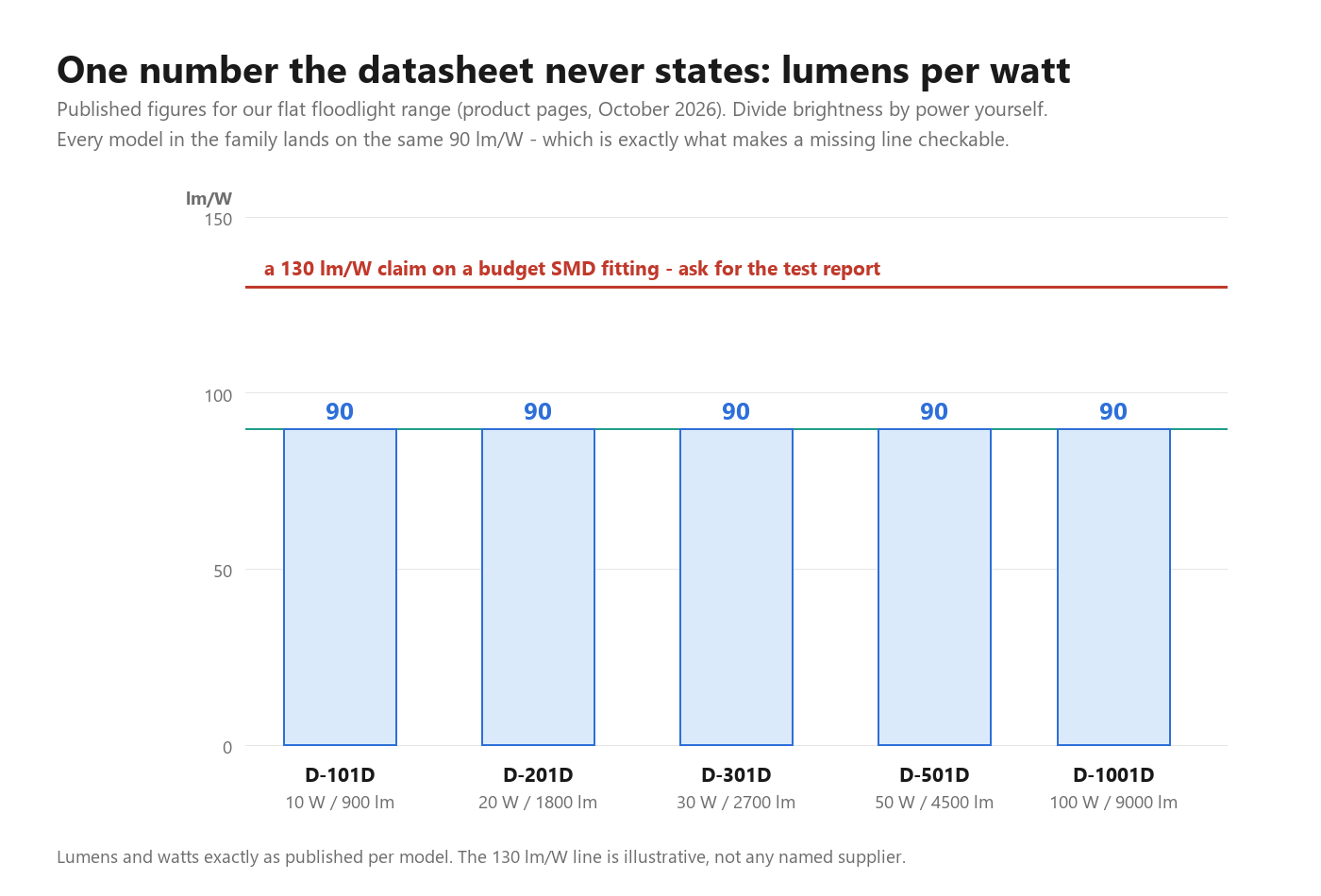
Every model in the range computes to 90 lm/W. A consistent line like this is itself a quality signal – it says one optical design, scaled.
Now the useful part. SMD2835 chips in an aluminium-bodied floodlight with a toughened glass lens sit, in volume production, solidly in the 80-110 lm/W band at the luminaire level. When a quotation claims 130 or 150 lm/W on that construction, something has to give: either the lumens are measured at the chip before driver and lens losses, or the figure is simply copied from a component brochure. That does not mean the claim is false – better constructions exist – but it means the burden of proof moves to the supplier. The question that settles it in one email: “Is the lumen figure measured on the finished luminaire, and can you send the photometric file (IES or LDT)?” A supplier with an integrating sphere and nothing to hide sends the file. One without it sends adjectives.
While auditing our own pages for this article, we found one model in our rechargeable line where the wattage and the lumen figure could not both be right at the family’s stated efficacy. We have flagged it for correction. That is precisely the class of error the ten-second division exists to catch – and no supplier, us included, is immune to it.
What 120 degrees actually covers
Beam angle is the most skipped line on floodlight datasheets, and the most consequential after efficacy. Our entire range publishes one angle – 120° – which makes coverage a matter of geometry you can do on paper.
A 120° beam thrown downward lights a circle roughly 3.5 times the mounting height in diameter (2 × height × tan 60°). Combine that with the lumens and you get the average illuminance across that circle, which is what an installer actually cares about:
| Model | Lumens | Mounting height | Lit circle | Average illuminance |
|---|---|---|---|---|
| D-101D | 900 lm | 3 m | 10.4 m | ≈11 lux |
| D-501D | 4500 lm | 4 m | 13.9 m | ≈30 lux |
| D-1001D | 9000 lm | 6 m | 20.8 m | ≈27 lux |
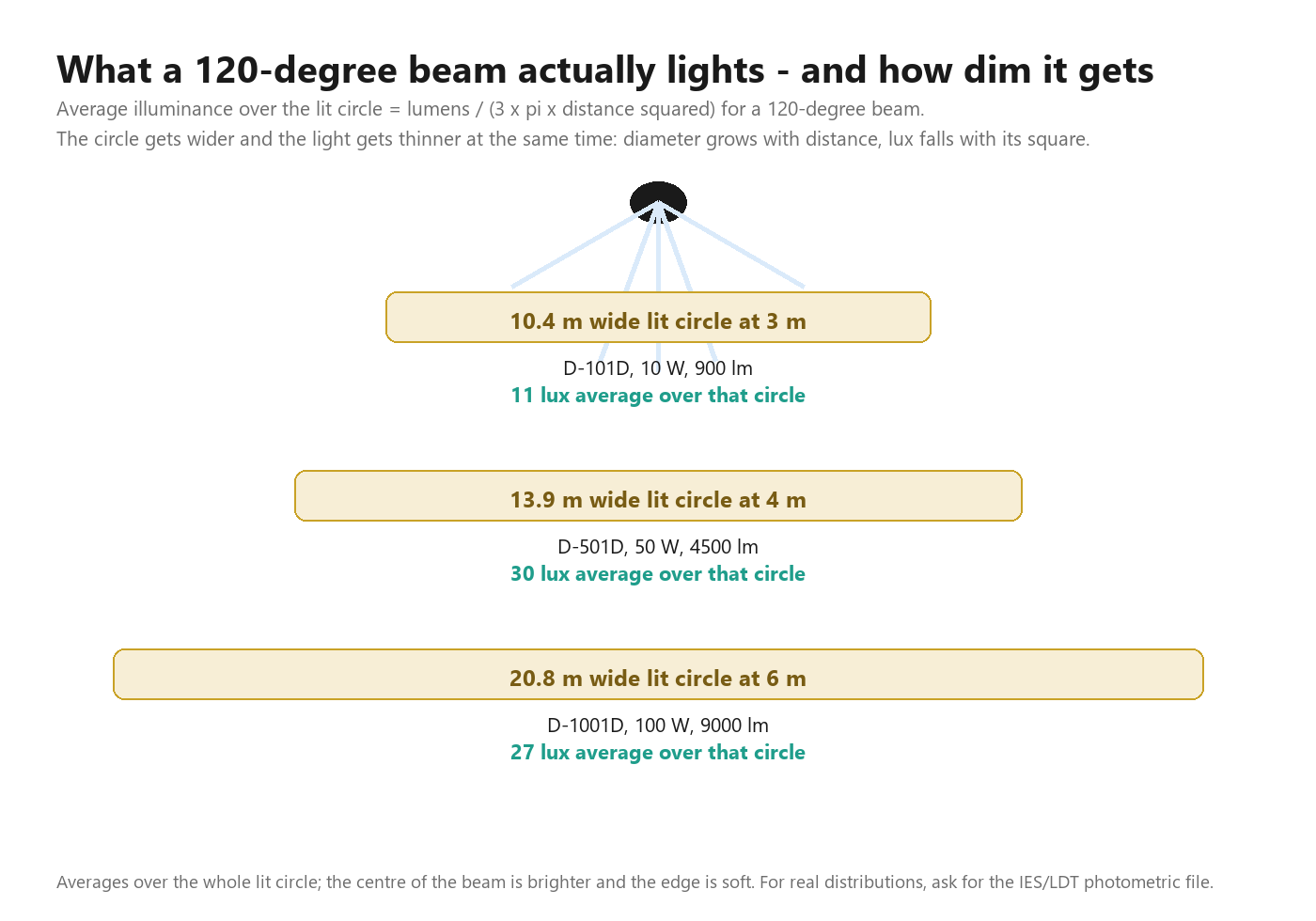
The circle widens as the lux thins: diameter grows with distance, illuminance falls with its square. Averages over the lit circle – the centre of the beam is brighter, the edge is soft.
Two honest caveats. First, these are averages over the whole lit circle with a hard cone assumed; a real 120° floodlight has no razor edge, and the beam centre runs brighter than the average. Second, for anything beyond a fence line or a car park, averages stop being enough – lighting standards for workplaces and roads are written in maintained lux at defined points, and you get there with a proper photometric file, not a datasheet line. Which is, again, the same question: ask for the IES/LDT file.
The practical takeaway for a catalogue buyer: a “more powerful” model is not automatically a “brighter site”. A 900 lm unit at 3 m and a 9000 lm unit at 6 m land on nearly the same average illuminance. Height and model have to be chosen together.
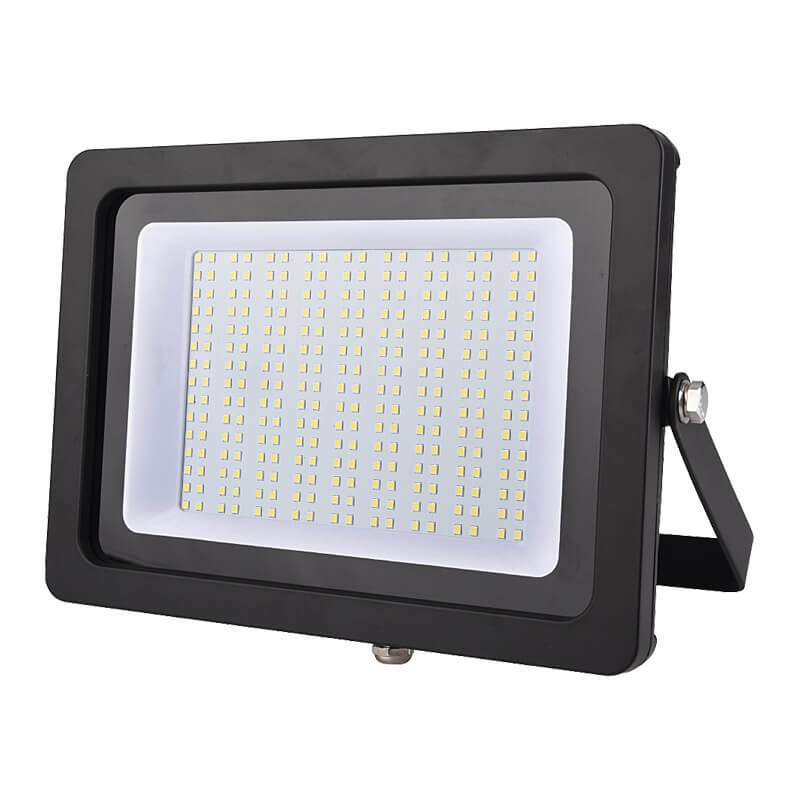
D-1001D: 100 W, 9000 lm, 295 mm wide. At 6 m it averages ≈27 lux over a 21-metre circle – a yard, not a football pitch.
Power factor is not efficiency – but the step in the table is a tell
Back to the first table. Look at the power-factor column: >0.5 up to 20 W, >0.9 from 30 W upward. Buyers sometimes read that as inconsistency. It is neither sloppiness nor marketing – it tracks the harmonics limits of IEC 61000-3-2, which set stricter requirements for lighting equipment above 25 W input. Below that threshold the requirement is lighter, and economy drivers are specced accordingly; above it, the driver has to do real power-factor and harmonic work, and the datasheet number steps up.
What power factor is not is efficiency. A fitting with PF 0.9 does not produce more light than one at 0.5 – the difference is what it draws from the grid: reactive current, harmonics, and how many fittings you can hang on one circuit or one site generator before breakers and voltage sag start voting. For a pallet of 10 W wall-pack units on a residential channel, PF 0.5 is a non-issue. For forty 100 W heads on a logistics yard fed by a generator, it is a specification line worth enforcing – and the datasheet that states it honestly is telling you which driver family is inside.
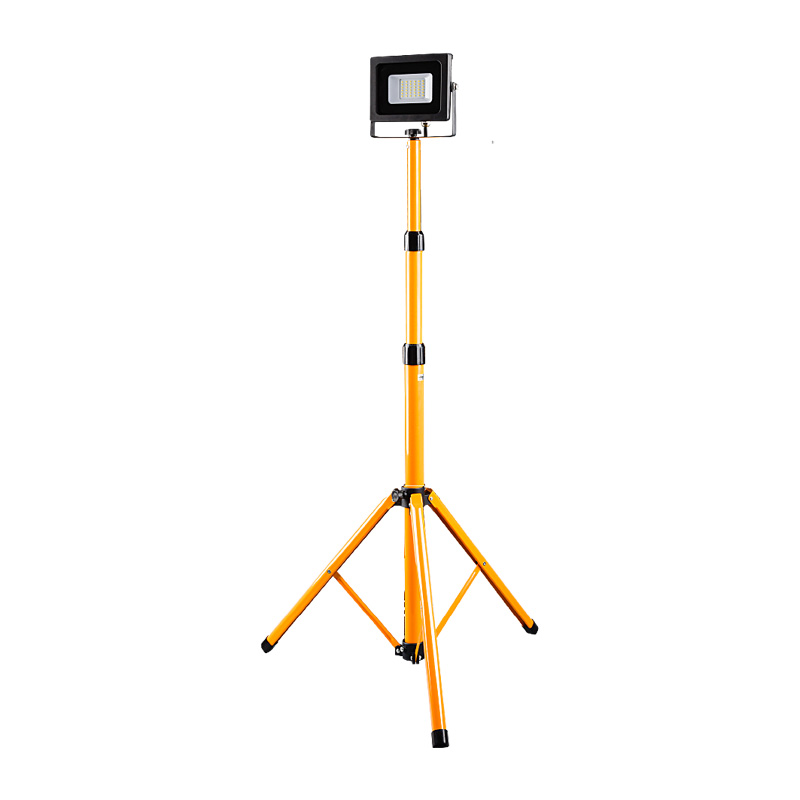
D-206D on its tripod: a 20 W head, power factor >0.5 – the band where the standard asks less and the datasheet should say so plainly.
“30,000 hours” is not a promise until you ask two questions
Every model in the range says 30,000 hours. So does almost every competitor’s datasheet, which should be the first clue that the line carries less information than it appears to.
Thirty thousand hours measured how, and ending where? Lumen maintenance is specified as a percentage: L70/B50 means the population is projected to still deliver 70 % of initial lumens, with half the sample below the curve at that point. A “30,000 hours” line with no criterion could mean L90 at 30,000 h or L50 – and those are different products. The test infrastructure behind the claim is named IES LM-80 (lumen maintenance of the LED package, run for thousands of hours at defined case temperatures) with TM-21 doing the extrapolation; the honest datasheets cite one, and the honest suppliers can produce the other. Ask both: “What lumen-maintenance criterion does the 30,000 h refer to, and is there LM-80 data for the LED?”
The second question is the one that actually predicts warranty claims: “Which driver is in it?” In field returns, the LED array is rarely what dies – the electrolytic capacitors in a cheap driver are. Two floodlights with identical chips and identical “30,000 h” lines can have meaningfully different service lives, and the difference is a component the datasheet’s lifetime line never mentions. Our range uses SMD2835 arrays throughout; driver brand is exactly the kind of line we confirm per quotation rather than print generically, and it is a fair question to put to any supplier, including us.
CRI >80 tells you less than it looks like
CRI >80 is the honest, boring baseline for outdoor work lighting: above it, colours stop being visibly wrong under the lamp. Fine. The number hides two things worth one email each.
Binning. CRI is a property of the LED type; the batch that ships is drawn from bins. Colour consistency is specified in SDCM (standard deviation of colour matching – MacAdam ellipses): ≤3 SDCM is the level at which two adjacent fittings stop looking like different purchases. Datasheets that print “3000/4000/6500 K” without a binning figure may deliver a wall that shades from warm white to neutral white along its length.
R9. The standard CRI average can hide poor rendition of deep red specifically (R9), which matters less on a loading bay and more anywhere skin, brick, food or branding is being judged under the light. For general site use, >80 with no R9 figure is defensible. For a retail facade or a garden centre, it is a question.
The voltage line that says OR
Ours reads: 110–130 V OR 220–240 V. That “OR” is doing real work. It means the range is built in two supply variants, not one universal-input fitting – and it means the variant has to be named at order time, because a container of 220–240 V heads landing on a 110 V market is a very expensive way to learn to read.
The 110–130 V variant exists for a reason buyers outside North America sometimes forget: the United Kingdom runs its construction-site power on 110 V centre-tapped supplies precisely to keep shock voltages low around wet ground and metalwork. A work light destined for UK sites is a different SKU from the same head sold for a German façade – same optics, different mains side. When you RFQ, name the destination market and the supply, not just the model.
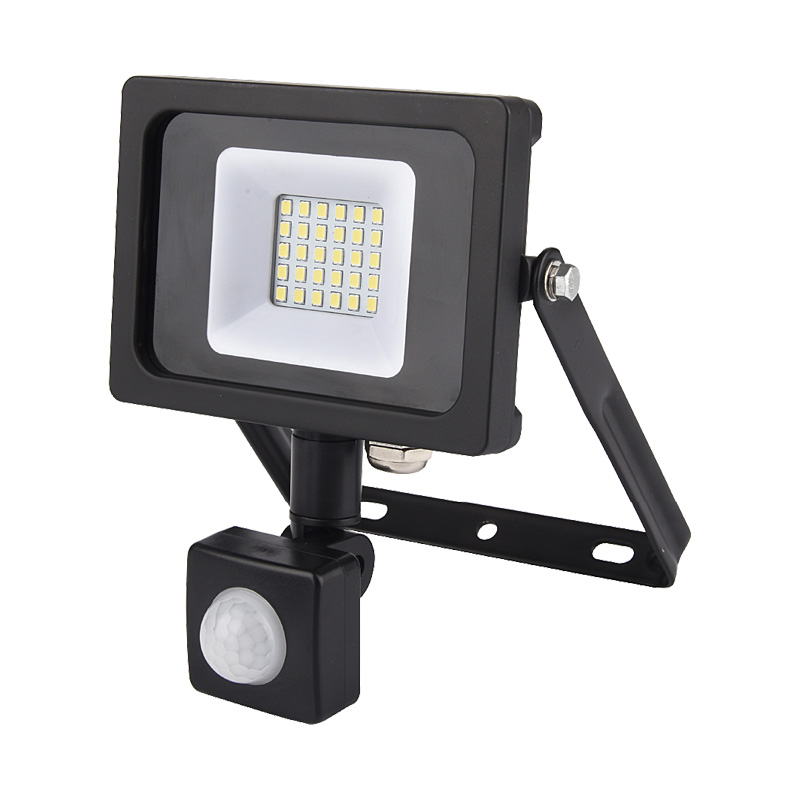
D-102D, 10 W with PIR sensor: same optical family, same two-variant mains side. The sensor version adds its own standby behaviour to the specification conversation.
IP is one line of a weather story
Our flat family is IP65 across the board; the rechargeable line is IP54. Those digits are IEC 60529 test results, and they matter – but they are the beginning of the weather conversation, not the end. An IP rating says nothing about impact resistance (that is IK, per IEC 62262), nothing about salt fog for coastal programmes, nothing about gasket compression after five winters of thermal cycling, and nothing about UV stability of anything plastic in the assembly.
We have covered that ground properly twice before – digit by digit in IP65, IP66 or IP67? How to Specify Outdoor LED Floodlights, and season by season in Outdoor Lighting That Survives Winter. Here it compresses to one line: the IP digit earns its place on the datasheet; everything it does not cover has to be asked for.
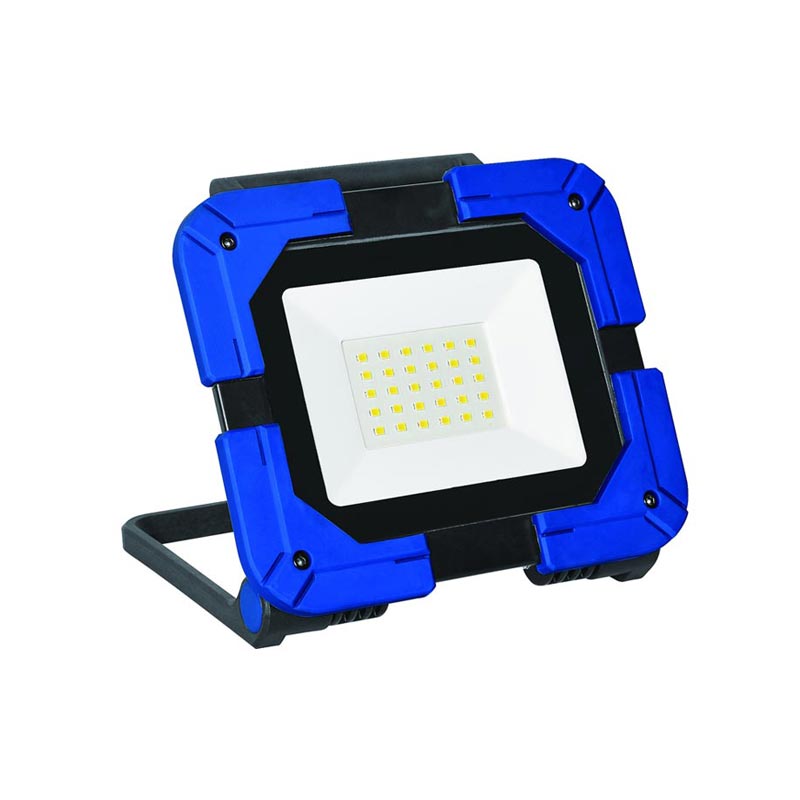
CD-203E: 20 W, 1700 lm, IP54, battery on board. Ruggedised housing – and still a fitting whose specification questions live mostly off the IP line.
The audit, in one picture
Everything above is one pass down a specification table. Put it on one page:
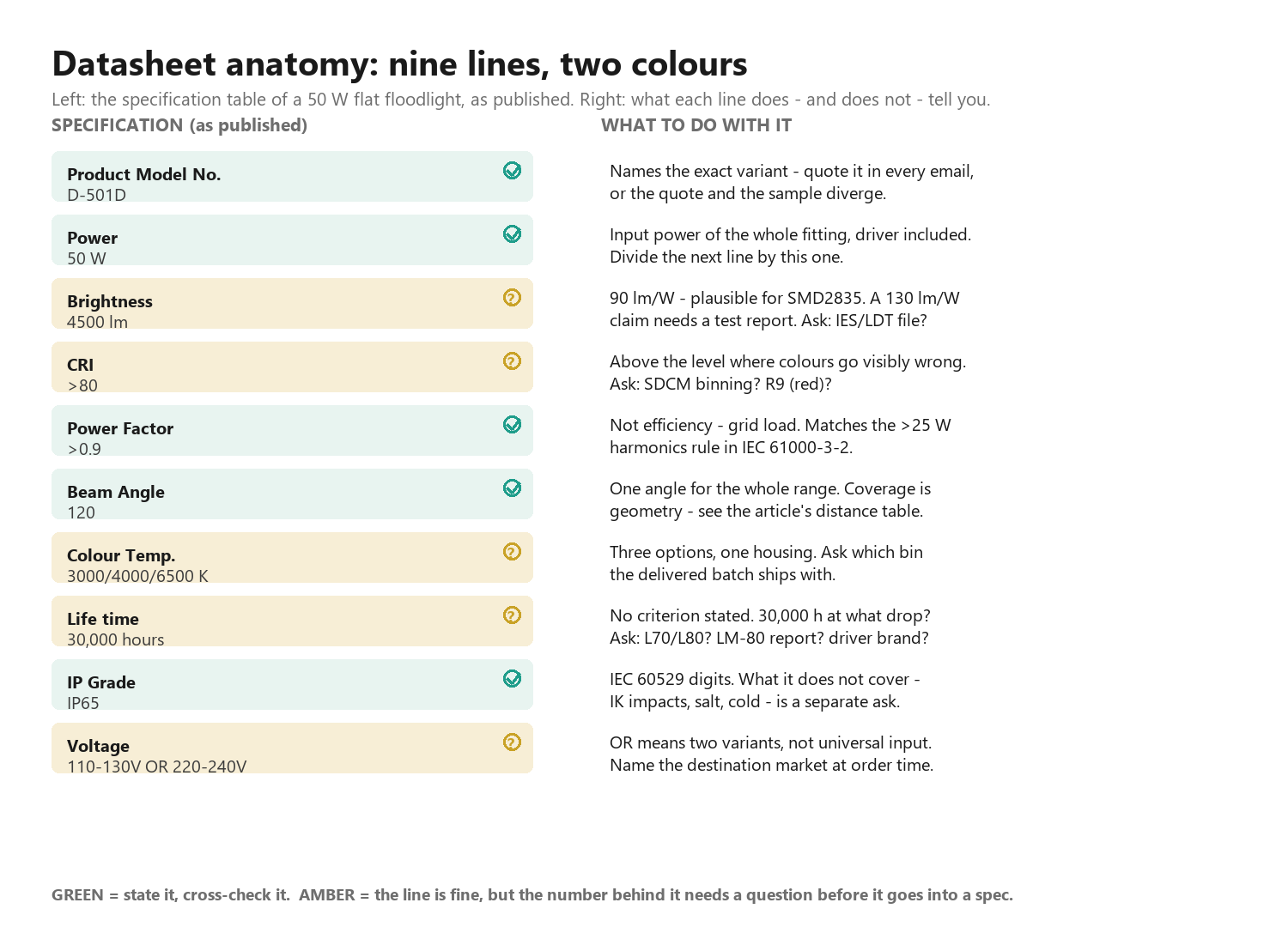
Green lines: state them and cross-check them. Amber lines: the number is fine, but what stands behind it needs a question before it goes into your spec.
And in table form, ready to lift into your next RFQ:
| Datasheet line | Cross-check | Question to send |
|---|---|---|
| Power + Brightness | Divide: 80–110 lm/W is the honest band for this construction | “Measured on the finished luminaire? Send the IES/LDT file.” |
| Beam angle | Diameter ≈ 3.5 × height; average lux = lm/(3π·h²) | “Photometric file for the 120° optics?” |
| Power factor | Step to >0.9 above ~25 W tracks IEC 61000-3-2 | “Driver brand and spec sheet?” |
| Life time | 30,000 h of what: L70? L90? B50? | “Lumen-maintenance criterion? LM-80 report for the LED?” |
| CRI >80 | Batch-level binning is the real variable | “SDCM figure? R9 value if colour matters.” |
| Colour temp | Three options, one housing – bins decide the wall | “Which CCT bin ships with the batch?” |
| IP grade | Real, but partial: no IK, salt, cold, UV | “IK rating? Salt-mist data if coastal.” |
| Voltage “OR” | Two variants, not universal input | “Confirm variant for the destination market.” |
What we publish, and what we do not
For balance: our own tables, the ones used throughout this article, do not state an IK rating, do not state SDCM binning, and do not attach LM-80 reports – which is exactly why this article asks you to send the questions rather than trust any datasheet, ours included. The figures we do publish – lumens, watts, power factor, beam angle, CCT options, IP, the two voltage variants – are on every floodlight product page, and the worked example above (D-501D, D-101D) is there to be checked against this article line by line.
One more honesty note while we are auditing: the audit found the discrepancy mentioned earlier in our own rechargeable line – wattage and lumens that could not both be right, plus a second line where the IP grade in the specification table did not match the product title. Both are flagged for correction. A datasheet is a sales document with numbers in it; the supplier worth working with is the one who runs the same audit on himself.
Send the questions, not the trust
If you are comparing suppliers this quarter, the fastest filter is not price and it is not the hero photo – it is how the supplier responds to the eight questions in the table above. The ones with an integrating sphere, driver documentation and LM-80 data answer in days with attachments. That response tells you more about the container you will actually receive than any datasheet line.
We are a lighting manufacturer in Ningbo. The floodlight and work light range behind this article spans 10–100 W mains heads, tripod and sensor variants, and rechargeable models – and if your application needs matching rather than auditing, the work light vs floodlight guide covers the selection side. Send the questions through our contact page or ask about customisation – and hold us to the same standard the article just taught you.
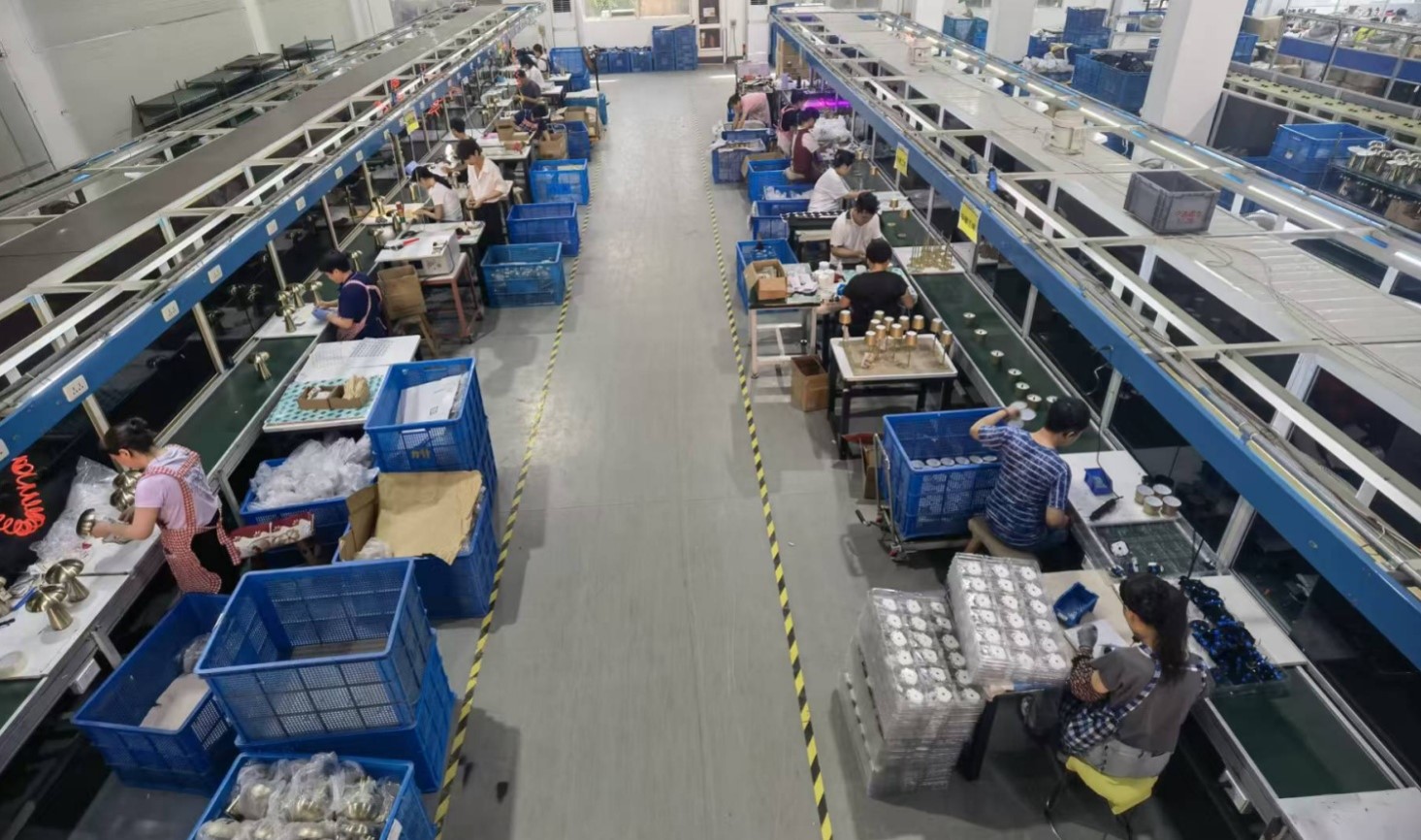
Assembly in Ningbo. Every figure in this article is published on a product page – check it, question it, and make us defend it.
about
Symbol Industrial
Supplier of outdoor lightings and electric products in China.
blog tags
related posts

October 20, 2026

September 23, 2026