

For the best part of a decade, UK importers of lighting and electrical products have kept an unresolved question in their purchasing files: do we need UKCA marking, or is CE still enough? In 2026 that question is settled for almost every product in this category — and the answer is not the one many suppliers are still quoting.
This article sets out where UK product marking actually stands, which parts of it affect LED lighting and electrical accessories, and what a buyer should ask a supplier before placing an order.
The short answer
CE marking is recognised in Great Britain — England, Scotland and Wales — indefinitely for the GB product regulations that mirror EU harmonisation law. UKCA still exists, but as a voluntary alternative for those same categories, not a requirement. There is no date currently in force on which CE marking stops being accepted.
For electrical equipment, EMC, radio equipment, RoHS, outdoor noise and machinery — the instruments behind almost everything a lighting importer buys — a lawfully CE-marked product can be placed on the GB market with no UKCA marking at all.
So if a supplier is still adding a mandatory “UKCA fee” to your quotation, ask which regulation they believe requires it. For most of this product family in 2026, the honest answer is none. That is not an argument against spending money on UK testing where it adds value — it is an argument against paying twice for the same conformity assessment.
How the position got here
| Date | What changed |
|---|---|
| 1 January 2021 | UKCA introduced as the GB mark; CE continued on a transitional basis |
| 2021–2022 | The deadline for mandatory UKCA was pushed back, twice |
| August 2023 | Government announced CE would be recognised indefinitely for most product categories |
| 2024 | The Product Safety and Metrology etc. (Amendment) Regulations gave the continued CE recognition legislative effect across a broad set of product regulations |
| 2025 | The arrangement was placed on a durable statutory footing, with CE recognised for the relevant GB regulations |
| 2026 | New GB machinery regulations removed the CE cut-off in that sector, keeping the GB framework aligned with the updated EU Machinery Regulation |
The direction of travel has been consistent for four years: recognition has only ever been extended, never withdrawn.
What this covers for lighting and electrical products
The recognition runs per GB instrument, not as a blanket statement, so it is worth confirming the specific one for anything unusual. For this product family the practical list is:
- Electrical Equipment (Safety) Regulations 2016 — the GB implementation of the Low Voltage Directive. This is the one that governs most AC-powered luminaires and socket products.
- Electromagnetic Compatibility Regulations 2016 — emissions and immunity.
- Radio Equipment Regulations 2017 — relevant if you buy smart, app-controlled, remote or sensor-triggered fixtures.
- RoHS Regulations — restricted substances.
- Outdoor noise and machinery instruments — relevant to powered site equipment rather than to a lamp itself.
A product that sits awkwardly between categories — a mobile work light with a built-in radio, for instance — should be checked against each instrument separately rather than assumed to fall under one.
Northern Ireland is a different market
Northern Ireland continues to follow EU product rules under the Windsor Framework. CE marking applies there, or UKNI together with CE where a UK approved body is involved. GB policy on the indefinite acceptance of CE does not change that.
If you distribute across the whole UK, your label artwork has to work for two regimes at once. A GB-only label, or a GB-only declaration of conformity, will not cover the Northern Ireland part of your range.
Where UKCA still matters
UKCA has not disappeared, and there are cases where it is still the right answer:
- Sectors outside the recognition arrangement run their own rules — medical devices and some transport and pressure-equipment categories among them. Manufacturers in these sectors should check the current position with their notified or approved body rather than assume.
- Transitional labelling relief: where a manufacturer has chosen the UKCA route, legislation currently allows the mark to appear on a label or accompanying document rather than being printed on the product itself until the end of 2027, and permits UKCA declarations to rest on CE conformity assessment work completed by the end of 2024.
- Commercial reasons. Some UK buyers, public tenders and specifiers still write UKCA into their requirements. If a customer contractually requires it, that is a reason to hold it — a commercial one, not a legal one.
The question that actually stops shipments: plugs
Separate from the marking discussion, anything shipped with a UK plug falls under its own GB instrument: the Plugs and Sockets etc. (Safety) Regulations 1994. This is where experienced importers do their real diligence.
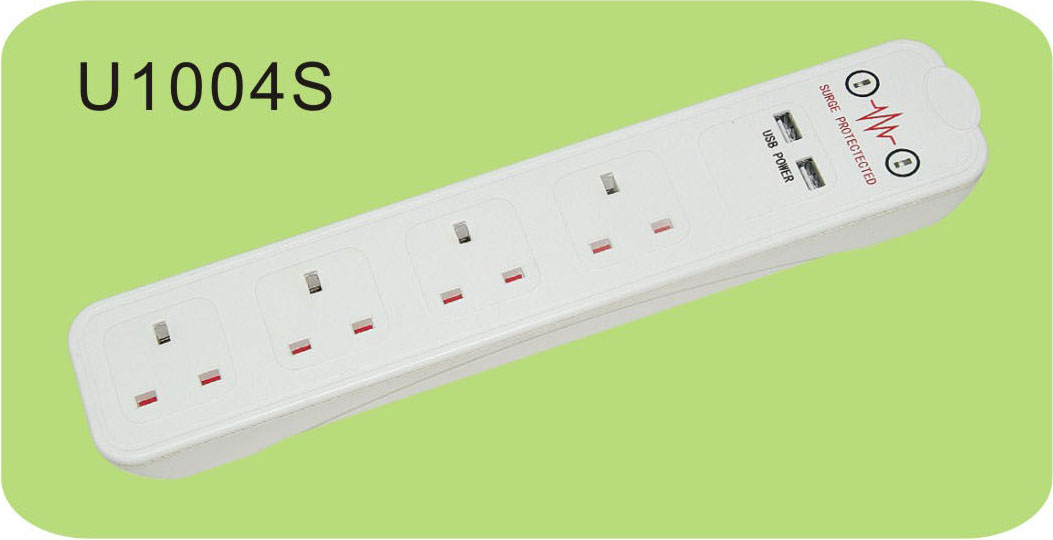
A UK-type extension lead from the Ningbo Symbol range. The plug, the socket-outlets and the finished lead each have their own compliance route.
Under that instrument, standard plugs must conform to BS 1363 and be approved by a notified body, carrying that body’s approval mark — the BSI Kitemark, the ASTA diamond, or an equivalent such as the Nemko N mark. A compliant plug is fused to BS 1362 at 13 A, has insulated sleeves on the line and neutral pins and a correctly sized earth pin.
One detail worth knowing: the Institution of Engineering and Technology has stated plainly that CE marking is not the appropriate mark for products covered by that regulation, and that a CE mark on a plug claiming to be made to BS 1363 is a reliable indicator of a counterfeit. Meanwhile, a completed extension lead, considered as electrical equipment rather than as a plug, still needs its CE or UKCA conformity route — and its socket-outlet section should conform to BS 1363-2.
Both statements are true at once, which is exactly why the distinction trips people up. A supplier who can explain it is worth keeping.
Seven things to request before you order
- The EU or GB Declaration of Conformity, naming the specific product and the standards applied — for a luminaire, expect references to EN 60598-1 and the relevant part of EN 60598-2, EN 62493 for electromagnetic fields, EN 55015 and EN 61547 for EMC, and EN 61000-3-2 for harmonics.
- Test reports from an accredited laboratory, not a certificate from a body that issues documents without testing.
- A RoHS declaration and a REACH SVHC statement.
- IP and IK evidence where the datasheet claims a rating, with a report number.
- Label artwork review — manufacturer name and address, product identification, electrical ratings, batch or serial traceability, and safety information in the language of the destination market.
- A named answer to who acts as the responsible economic operator in the EU, and who carries that role for the UK side.
- Written confirmation of which marking route the product is on — CE under the GB recognition arrangement, or UKCA.
Items 5 and 6 are the two that most often surface a genuine problem after the container has sailed.
Why this matters commercially
Two reasons. The first is cost and lead time: duplicated conformity work for a product that is already CE-marked adds weeks and real money, for no safety benefit that any UK authority has claimed. The second is that UK buyers increasingly audit the technical file rather than the invoice — and a supplier who cannot say which regulation their product is placed under will eventually be replaced by one who can.
If you are sourcing outdoor lighting or electrical accessories for the UK or the EU and want a supplier who can tell you exactly which conformity route your product is on, talk to us about your next project. You can see our UK type extension sockets and LED floodlights ranges for reference.
about
Symbol Industrial
Supplier of outdoor lightings and electric products in China.